
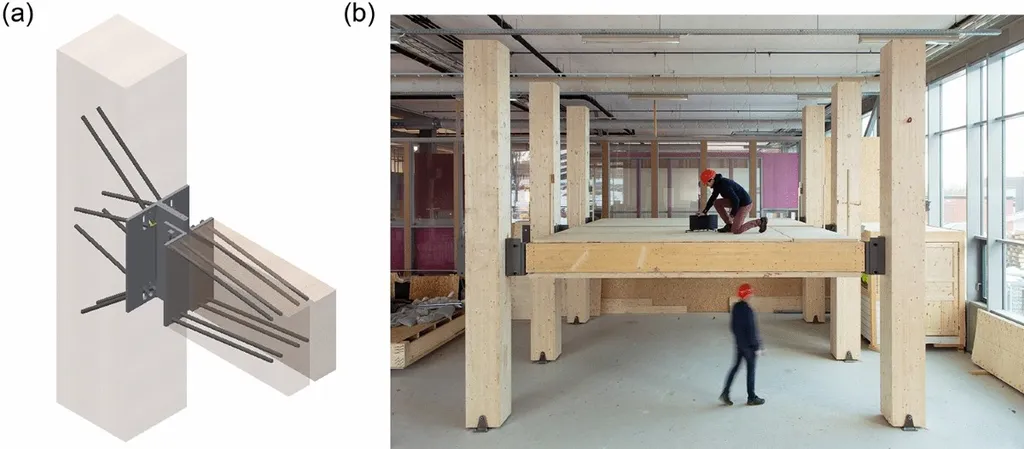
In the ever-evolving world of construction, timber frames are making a comeback, but not without their challenges. One of the key hurdles has been the efficient transmission of moments between beam and column connections. Enter Alexia Brandao Ribeiro from the ISISE – Institute for Sustainability and Innovation in Structural Engineering at the University of Coimbra, who has been delving into this very issue. Her recent work, published in ‘Informes de la Construccion’ (translated to ‘Construction Reports’), offers a fresh perspective on moment-resisting connections for timber frames, with implications that could resonate through the energy sector.
The crux of the problem lies in the discontinuity of wood fibres at intersections, which can hinder the transmission of moments. Ribeiro explains, “The challenge is to find engineering solutions that can effectively transmit these moments, ensuring the structural integrity and stability of timber frames.” Her research explores various mechanical principles that address this issue, each with its unique approach.
One widely adopted solution is the polygonal arrangement of connectors. These connectors are inserted perpendicularly to the bending plane and act in shear, providing a straightforward yet effective means of transmitting moments. Another intriguing solution is the lever mechanism, which balances the moment through a torque created by the tension of a metal connector and compression against the wood. Ribeiro elaborates, “This mechanism is akin to a seesaw, where the tension and compression forces balance each other out, ensuring the transmission of the moment.”
Innovation is at the heart of Ribeiro’s research, and she highlights an innovative proposal involving reinforced concrete nodes. In this solution, the continuity of the bending moment is ensured by glued-in rods anchored in the timber beam and column with structural epoxy resin. This approach not only enhances the moment-resisting capacity but also opens up new possibilities for hybrid timber-concrete structures.
Another solution explored in Ribeiro’s work is the pre-stressed connection. Here, the balancing moment is achieved by adjusting the compressive stresses introduced by the prestress. This method offers a unique way of ensuring the structural performance of timber frames, potentially leading to more efficient and cost-effective designs.
The commercial impacts of this research could be significant, particularly for the energy sector. As the push for sustainable and energy-efficient buildings grows, timber frames are becoming an increasingly attractive option. However, their widespread adoption hinges on overcoming technical challenges such as moment-resisting connections. Ribeiro’s work could pave the way for more robust and efficient timber frame structures, making them a viable option for a broader range of applications.
Looking ahead, Ribeiro’s research could shape future developments in the field of timber construction. By providing a comprehensive review and comparison of different moment-resisting solutions, she offers valuable insights that could guide engineers and architects in their design choices. Moreover, her work highlights the potential of innovative solutions, such as reinforced concrete nodes and pre-stressed connections, which could open up new avenues for research and development.
In the words of Ribeiro, “The future of timber construction lies in our ability to innovate and adapt. By addressing the challenges of moment-resisting connections, we can unlock the full potential of timber frames and contribute to a more sustainable built environment.” With her research published in ‘Informes de la Construccion’, Ribeiro is undoubtedly making strides in this direction, offering a beacon of inspiration for the construction industry.