
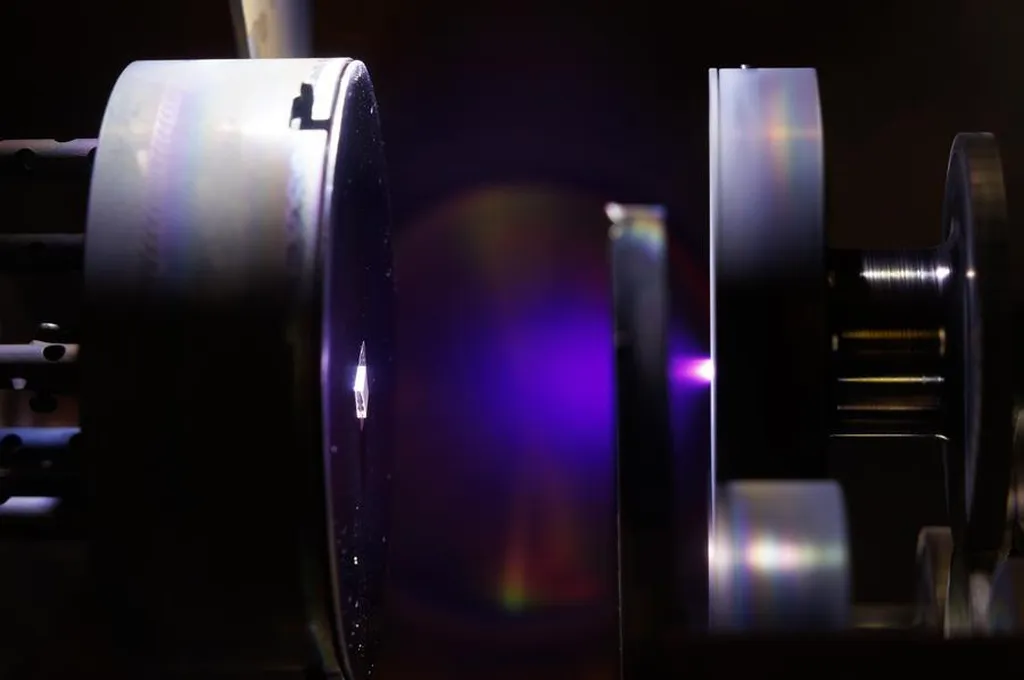
In the heart of France, at the Laboratoire Albert Fert, CNRS, Thales Université Paris Saclay, a team of researchers led by Elzbieta Gradauskaite has been making waves in the world of materials science. Their focus? Layered ferroelectric thin films, a class of materials that could potentially revolutionize the energy sector. Their findings, published in the journal ‘Small Science’ (translated to English as ‘Small Science’), are not just academic exercises; they’re paving the way for innovative applications in energy storage, sensing, and more.
Layered perovskites, a versatile class of ferroelectrics, have long been considered too complex to prepare as high-quality thin films. However, Gradauskaite and her team have shattered this notion. “We’ve made significant breakthroughs in deposition and advanced characterization,” Gradauskaite explains. “This has allowed us to stabilize epitaxial films with atomic-scale control, uncovering novel ferroelectric functionalities.”
So, what does this mean for the energy sector? Ferroelectric materials have a unique ability to retain polarization in the absence of an external electric field. This property is crucial for energy storage applications. The team’s research has revealed that these materials can exhibit robust in-plane polarization without a critical thickness, a feature that could lead to more efficient and compact energy storage devices.
Moreover, the team has discovered that these materials can be integrated into standard perovskite heterostructures. This opens up a world of possibilities for creating multifunctional devices that combine ferroelectricity with other properties, such as magnetism or conductivity. “This could lead to the development of novel devices for energy harvesting, sensing, and data storage,” Gradauskaite suggests.
The team’s research also highlights the resilience of these materials to doping with magnetic ions and charge carriers. This resilience could make them ideal for use in harsh environments, such as those found in industrial settings or space applications.
Looking ahead, the team is exploring several promising research directions. These include polar metallicity, (alter-)magnetoelectricity, exfoliation, and soft-chemistry-driven phase transformations. Each of these areas holds the potential for groundbreaking discoveries that could shape the future of the energy sector.
In the words of Gradauskaite, “We hope our work encourages further exploration of these materials for both fundamental studies and applications.” With their recent breakthroughs, they’re well on their way to making that hope a reality. As the world grapples with the challenges of climate change and energy sustainability, the work of Gradauskaite and her team offers a beacon of hope and a path forward.