
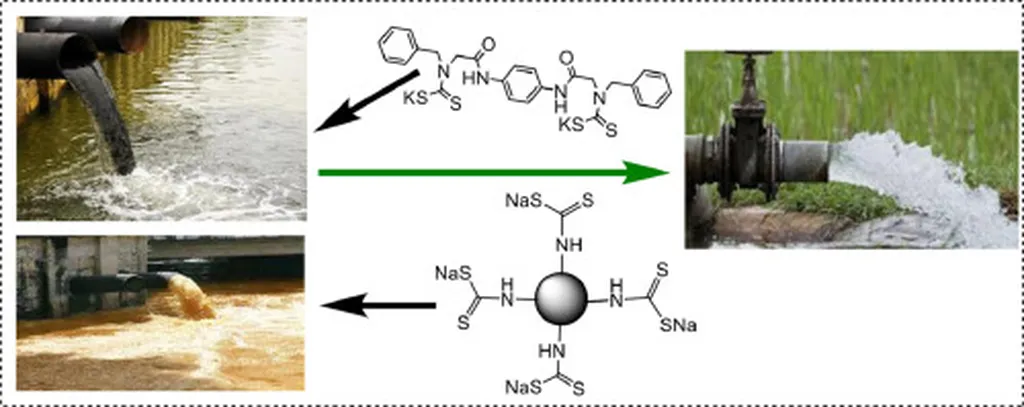
In the quest to mitigate environmental pollution, researchers have been exploring innovative materials to remove toxic heavy metal ions (HMIs) from water. A recent review published in the journal *Advances in Materials Science and Engineering* (which translates to *Advances in Materials Science and Engineering* in English) sheds light on a promising approach using ligand-engineered mesoporous silica (MPS). The study, led by Shah Hussain from the Department of Chemistry, highlights the potential of this cutting-edge material to revolutionize heavy metal sequestration, with significant implications for the energy sector.
Mesoporous silica, known for its high surface area and tunable pore size, has been a subject of interest in various applications. However, the real game-changer here is the functionalization of MPS with organic ligands. “Ligand-functionalized MPS exhibits excellent surface properties, making it a highly efficient and selective adsorbent for various toxic HMIs,” Hussain explains. The review focuses on the adsorption of HMIs like Pb(II), Co(II), Hg(II), Pd(II), Ce(III), Se(IV), and As(V), comparing the performance of ligand-modified MPS with other materials.
The study reveals that the adsorption data of HMIs onto ligand-engineered MPS are best fitted in the pseudo-second-order and Langmuir models. These models suggest a homogeneous distribution of adsorption sites and monolayer formation of the adsorbate onto the surface of the conjugate adsorbent. In simpler terms, the material’s surface is uniformly covered with a single layer of heavy metal ions, maximizing its adsorption capacity.
The implications of this research for the energy sector are substantial. Heavy metals are often byproducts of energy production and can contaminate water sources, posing significant environmental and health risks. Efficient and selective adsorbents like ligand-engineered MPS can help energy companies comply with environmental regulations, reduce cleanup costs, and minimize their ecological footprint.
Moreover, the ability to tailor the properties of MPS through ligand functionalization opens up avenues for developing custom adsorbents tailored to specific industrial needs. This could lead to more efficient and cost-effective solutions for heavy metal sequestration, benefiting not only the energy sector but also other industries grappling with similar challenges.
As Hussain points out, “Further research is recommended to enhance the ability of hybrid adsorbents.” This suggests that the journey has just begun, and the future holds even more promise. The development of more advanced and efficient adsorbents could pave the way for a cleaner, safer, and more sustainable energy landscape.
In conclusion, the review by Hussain and his team underscores the potential of ligand-engineered mesoporous silica as a game-changer in heavy metal sequestration. As the energy sector continues to grapple with environmental challenges, innovative solutions like these could play a pivotal role in shaping a more sustainable future.