
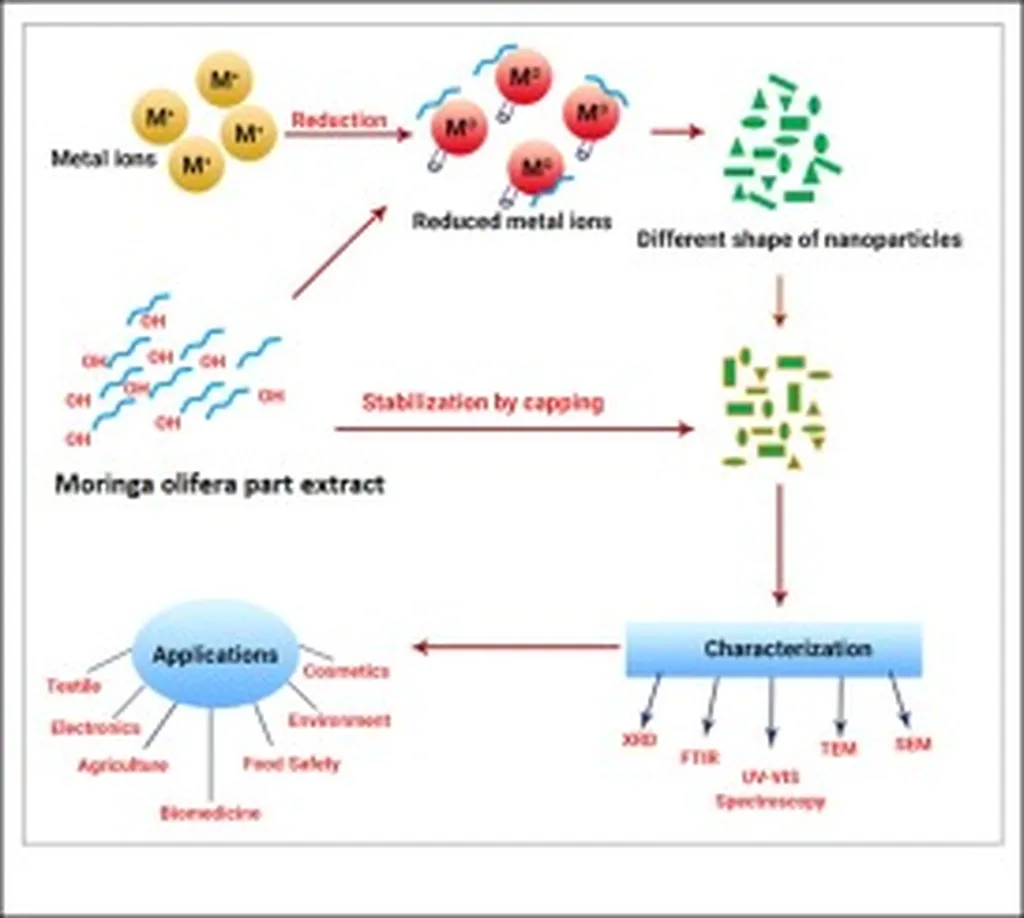
In a groundbreaking study published in the journal *Advances in Materials Science and Engineering* (which translates to *Advances in Materials Science and Engineering* in English), researchers have unveiled a novel approach to synthesizing magnetite nanoparticles using the antioxidant-rich phytochemicals of Moringa oleifera. This innovative method not only enhances the nanoparticles’ functionality but also addresses critical limitations in conventional synthesis, such as agglomeration, instability, and systemic toxicity. The lead author, Sushmita Bista from the Department of Biomedical Engineering, explains, “Our study demonstrates the potential of plant-derived nanoconjugates to enhance nanoparticle functionality without relying on toxic reagents.”
The research focuses on the growing prevalence of drug-resistant bacterial infections and the systemic toxicity associated with conventional cancer therapies. By employing a plant-based biofunctionalization strategy, the study successfully integrates antioxidant-rich phytochemicals from Moringa oleifera leaf extract to facilitate nanoparticle formation. This approach not only improves surface functionality and colloidal stability but also enhances biological efficacy.
Comparative synthesis using conventional co-precipitation (Fe3O4) and Moringa-mediated biosynthesis (MO-Fe3O4) revealed that the MO-Fe3O4 nanoparticles exhibited superior physicochemical properties. These included a smaller crystallite size, higher colloidal stability, and a narrower band gap, indicative of enhanced surface reactivity. Functionally, MO-Fe3O4 demonstrated stronger antibacterial activity against Staphylococcus aureus and Escherichia coli, with larger inhibition zones and lower MIC values compared to chemically synthesized Fe3O4.
Furthermore, cytotoxicity assays revealed potent antiproliferative effects on HeLa cancer cells with minimal impact on normal fibroblast cells, confirming biocompatibility. “The Moringa-capped Fe3O4 nanoparticles integrate antioxidant-rich capping with magnetic core properties, offering dual-action antimicrobial and anticancer capabilities,” Bista notes.
The implications of this research are vast, particularly for the energy sector. The development of biocompatible and environmentally sustainable nanomaterials could revolutionize various industries, including energy storage and conversion. The enhanced functionality and stability of these nanoparticles could lead to more efficient and safer applications in energy technologies.
As the world continues to seek sustainable and effective solutions to combat drug-resistant infections and cancer, this study underscores the potential of integrating traditional medicinal resources with modern nanotechnology. The findings pave the way for future developments in the field, offering a promising avenue for the creation of functional nanomaterials that are both biocompatible and environmentally sustainable.
In the words of Bista, “This research not only addresses critical limitations in conventional nanoparticle synthesis but also opens new possibilities for the application of plant-derived nanoconjugates in various industries.” The study’s publication in *Advances in Materials Science and Engineering* further solidifies its significance and potential impact on the scientific community and beyond.