
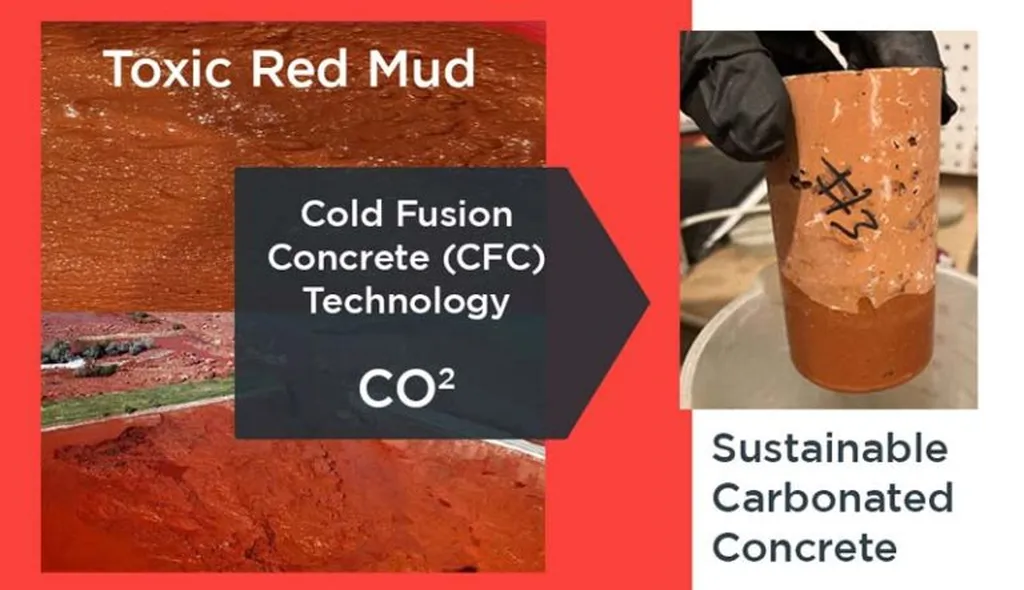
In a groundbreaking study published in the journal *Cleaner Engineering and Technology* (translated from Spanish as “Cleaner Engineering and Technology”), researchers have uncovered a promising avenue for recycling red mud (RM), a byproduct of the alumina refining process, into a multifunctional photocatalyst within cementitious composites. This innovation not only addresses environmental remediation but also offers significant economic benefits for the construction and energy sectors.
Gurbir Kaur, the lead author of the study and a researcher at the MATCH Research Group, Department of Chemistry, School of Sciences, University of Navarra, Spain, and the Department of Civil Engineering, Thapar Institute of Engineering and Technology, Patiala, India, explains, “Our research demonstrates that red mud can be effectively incorporated into cementitious composites, enhancing their photocatalytic activity while reducing embodied CO2 emissions and costs.”
The study explores the potential of red mud as a partial substitute for cement, incorporating it at levels up to 15% by weight in mortars. The researchers assessed various forms of red mud, including oven-dried and thermally treated samples (at 300°C and 600°C), to evaluate their impact on hydration, workability, strength, microstructure, leaching behavior, and embodied CO2 emissions.
One of the most compelling findings is the enhanced photocatalytic efficiency of the red mud mortars, which achieved over 8% nitrogen oxide (NOx) removal under solar and visible light irradiation. This performance meets Class 3 air-purification criteria, making it a viable option for environmental remediation.
“TiO2 coated RM samples showed 51% higher visible-light NOx abatement than control, attributed to strong interactions between TiO2 and RM’s hematite phase,” Kaur notes. This finding underscores the potential of red mud as a high-value additive that couples waste valorization with photocatalytic air-pollution mitigation.
The study also confirmed the environmental safety of red mud incorporation, with over 99% immobilization of trace elements and controlled alkali release. Moreover, substituting 15% of cement with red mud reduced CO2 emissions by approximately 12%, costs by about 7%, and life-cycle costs by around 3.5%.
The implications of this research are far-reaching. By valorizing red mud, a waste product that poses significant disposal challenges, the construction industry can not only reduce its environmental footprint but also create more sustainable and cost-effective building materials. The enhanced photocatalytic activity of these composites offers a scalable route toward greener construction materials, which can contribute to cleaner air and improved public health.
As the world seeks innovative solutions to address environmental challenges, this research highlights the potential of red mud as a valuable resource. The findings published in *Cleaner Engineering and Technology* provide a compelling case for the adoption of red mud in cementitious composites, paving the way for a more sustainable future in the construction and energy sectors.