
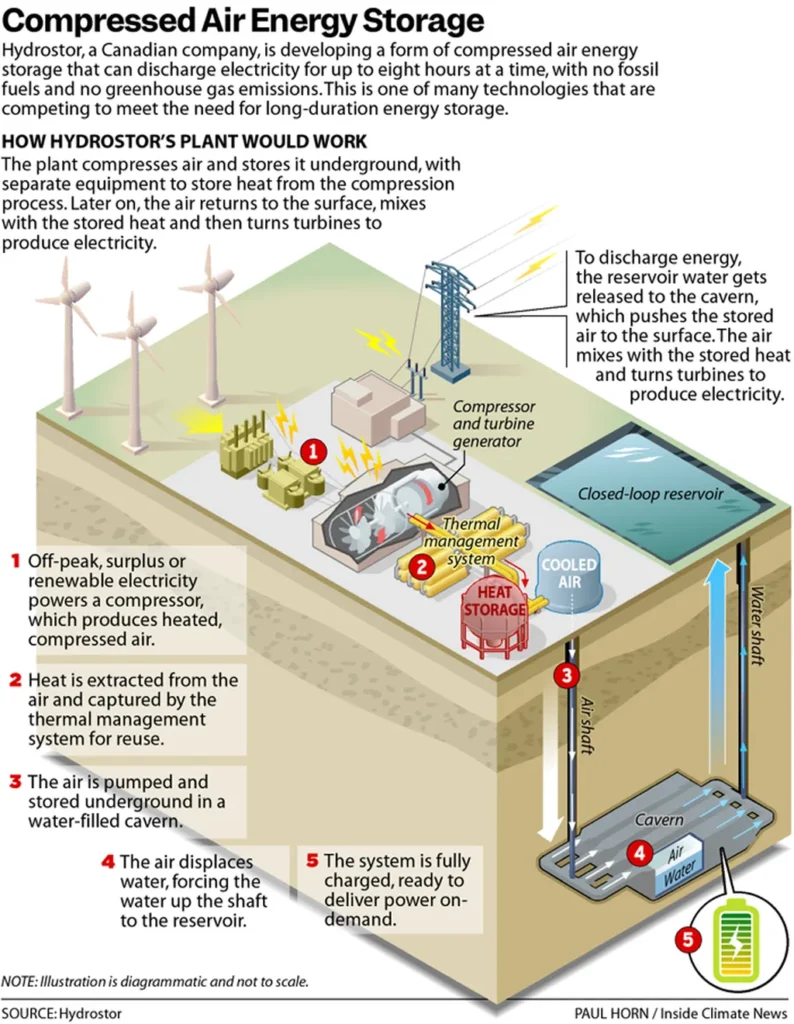
In the quest for sustainable energy solutions, researchers have turned their attention to compressed air energy storage (CAES) systems, which could play a pivotal role in balancing the intermittent nature of wind and solar power. A recent study published in *Zhileng xuebao* (Journal of Propulsion Technology) delves into the dynamic characteristics and thermodynamic constraints of non-supplementary-fired CAES systems driven by fluctuating wind and solar power. Led by Zhang Yuchen and colleagues, this research offers valuable insights into how renewable energy fluctuations impact CAES systems and provides a roadmap for enhancing their adaptability and efficiency.
The study developed a full-range dynamic simulation model of a non-supplementary-fired thermal storage CAES system, driven by coupled photovoltaic and wind power sources. By generating turbulent wind-speed sequences based on the Davenport wind-speed spectrum and combining them with PV power, the researchers constructed a second-level fluctuating power input to drive a multistage compressor unit. This approach allowed them to extract parameter trends using the moving-average method, revealing the dynamic response mechanisms of the system under fluctuating excitations.
“The results indicated that input power disturbances of ±31.66% induced severe fluctuations in the compressor speed (±8.6%) and pressure ratio (±13.39%),” explained Zhang Yuchen. “This was accompanied by a maximum temperature rise of 153.08 K in the single-stage exhaust gas and synchronous oil temperature fluctuations of 38.2 K in the interstage heat exchangers.”
One of the key findings was the significant thermodynamic inertia effects observed in the air and high-temperature thermal storage tanks, which validated the disturbance-filtering capability of the downstream energy-storage units. However, the non-supplementary-fired constraints posed a challenge: the interstage reheating temperature of the turbines could not exceed the upper limit of the thermal-storage medium temperature. As a result, when the expansion ratio decreased from 4.447 to 1.470, the turbine exhaust temperature increased to 513.1 K, rendering 18.3 tons of high-pressure air (2.133 MPa) incapable of effective work output.
This research elucidates the multi-timescale dynamic coupling mechanisms of CAES under renewable-energy fluctuations, providing theoretical support for enhancing system adaptability under variable operating conditions. The findings offer a guiding framework for thermodynamic optimization, which could have significant commercial impacts for the energy sector. As the world continues to transition towards renewable energy sources, the ability to store and manage energy efficiently becomes increasingly crucial. CAES systems, with their potential for large-scale energy storage, could play a vital role in this transition.
The study by Zhang Yuchen and colleagues, published in *Zhileng xuebao* (Journal of Propulsion Technology), sheds light on the complexities of integrating renewable energy sources with CAES systems. By understanding and addressing the dynamic characteristics and thermodynamic constraints, researchers and engineers can work towards developing more robust and efficient energy storage solutions. This, in turn, could pave the way for a more sustainable and resilient energy infrastructure, benefiting both the environment and the economy.