
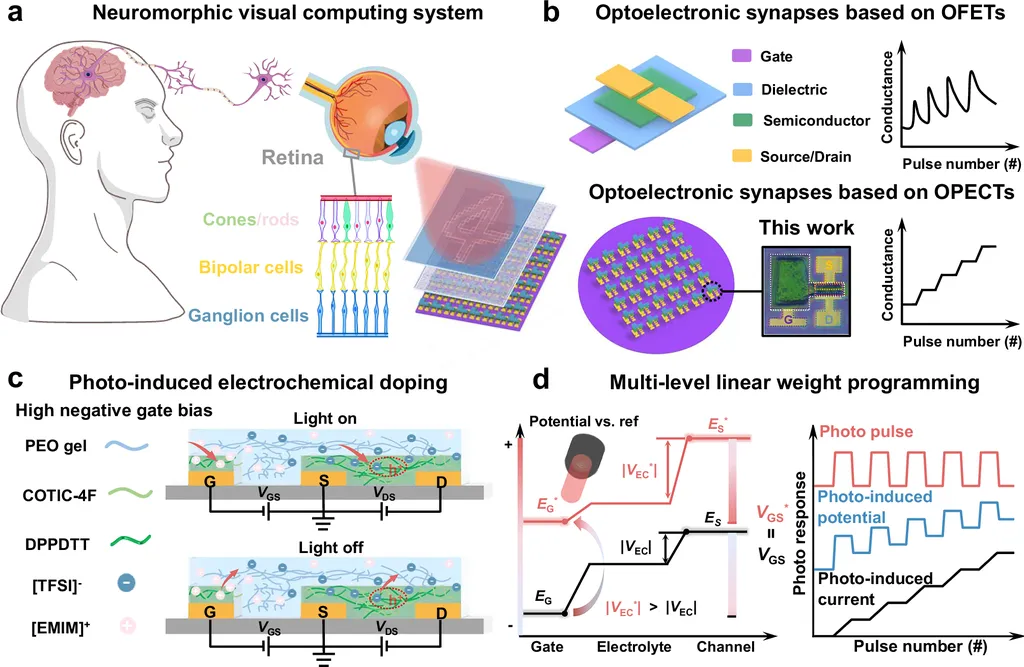
In a significant stride towards advancing neuromorphic electronics, researchers have developed a novel approach to integrate processing and memory functionalities in organic electrochemical transistors (OECTs). This breakthrough, published in the journal *npj Flexible Electronics* (which translates to *npj Flexible Electronics*), could have profound implications for the energy sector and beyond.
The study, led by Mancheng Li from the State Key Laboratory of Optoelectronic Materials and Technologies at Sun Yat-Sen University, introduces a regionally controlled ion-doping strategy. This method allows OECTs to switch between high-performance computing and non-volatile memory modes without altering materials or operating conditions.
At the heart of this innovation lies the use of inkjet-printed electrolytes with programmable 3D architectures. These electrolytes can be precisely deposited onto the OECT channel, achieving a tunable thickness ranging from 100 nanometers to several tens of micrometers. By engineering the electrolyte’s spatial structure, the researchers demonstrated two complementary OECT configurations: ion-rich OECTs with multilayer electrolytes for dynamic computation and ion-deficient OECTs with single-layer electrolytes for stable ion-trapping memristive states.
“This strategy overcomes material compatibility constraints and simplifies circuit design,” said Li, highlighting the versatility and potential of the new approach. The integration of ion-rich and ion-deficient OECTs enables a neuromorphic circuit capable of simultaneous encoding and storage of alphanumeric information, a feature that could revolutionize data processing and storage in various industries, including energy.
The energy sector, in particular, stands to benefit from this advancement. Neuromorphic systems that can efficiently process and store data could enhance energy management systems, optimize power grids, and improve the performance of renewable energy technologies. The ability to integrate computing and memory functionalities in a single device could lead to more compact, energy-efficient, and cost-effective solutions.
The research not only paves the way for highly integrated neuromorphic systems based on OECTs but also sets a precedent for future developments in the field. As the demand for more sophisticated and efficient electronic systems grows, innovations like this will be crucial in meeting the evolving needs of various industries.
In the words of the researchers, this study presents a “simple yet effective strategy” that could shape the future of neuromorphic electronics and beyond. The implications of this research are vast, and its impact on the energy sector and other industries could be transformative. As the field continues to evolve, the potential applications of these advanced technologies are limited only by our imagination.