
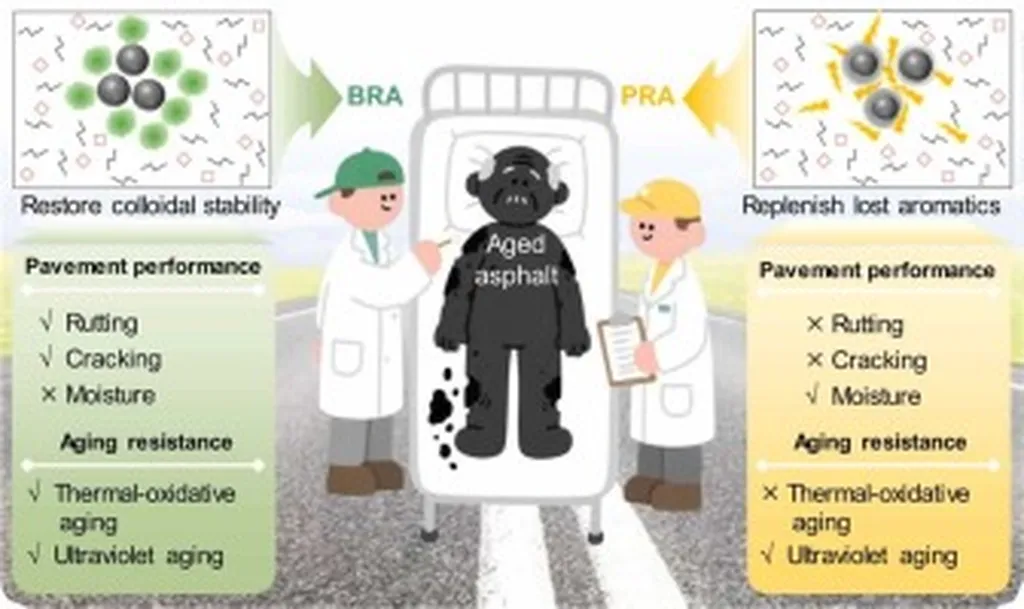
In the quest for sustainable and efficient road construction materials, a recent study published in the journal *Materials & Design* (translated from Turkish as “Materials and Design”) offers promising insights. The research, led by Mustafa Kurban from the Department of Prosthetics and Orthotics at Ankara University, explores the use of bio-based rejuvenators to restore aged asphalt binders, a critical component in reclaimed asphalt pavement (RAP).
The study integrates both experimental and computational methods to evaluate the performance of two novel bio-based additives, 1T and 2T, in rejuvenating aged asphalt binders. The aged binder, sourced from RAP, was modified with 25% by weight of each rejuvenator, denoted as 1T25 and 2T25, respectively. The results are intriguing and hold significant implications for the energy and construction sectors.
Using SARA (Saturates, Aromatics, Resins, Asphaltenes) fractionation and colloidal indices, the researchers assessed the compositional recovery of the binders. Both additives increased the aromatic and resin contents while reducing asphaltenes. Notably, the 2T-modified binder achieved the highest colloidal stability (Ic = 0.29) and showed the most pronounced improvement in stability indicators (CI and Ic) among the tested systems.
Mustafa Kurban, the lead author, explained, “Our findings suggest that bio-based rejuvenators can effectively restore the properties of aged asphalt binders, making them suitable for reuse in road construction. This not only reduces the need for virgin materials but also contributes to sustainability efforts in the construction industry.”
Complementary molecular dynamics (MD) simulations using the COMPASSII force field provided deeper insights into the structural and thermodynamic behavior of RAP and rejuvenated systems. The 2T25 system exhibited higher density and more compact molecular packing, indicating stronger cohesive organization and reduced free volume. In contrast, the 1T25 system showed greater molecular spacing and flexibility.
Kurban added, “The MD simulations acted as a mechanistic bridge, interpreting the experimental SARA/CI/Ic trends and supporting the design-oriented development of sustainable rejuvenators. This dual approach enhances our understanding of the rejuvenation process and its potential applications.”
The study’s findings could shape future developments in the field by promoting the use of bio-based rejuvenators in road construction. This approach not only addresses environmental concerns but also offers economic benefits by reducing the reliance on virgin materials. As the construction industry continues to seek sustainable solutions, the integration of bio-based rejuvenators could become a standard practice, paving the way for more eco-friendly and cost-effective road construction methods.
In summary, the research published in *Materials & Design* provides a compelling case for the use of bio-based rejuvenators in restoring aged asphalt binders. The insights gained from this study could significantly impact the energy and construction sectors, promoting sustainability and efficiency in road construction.