
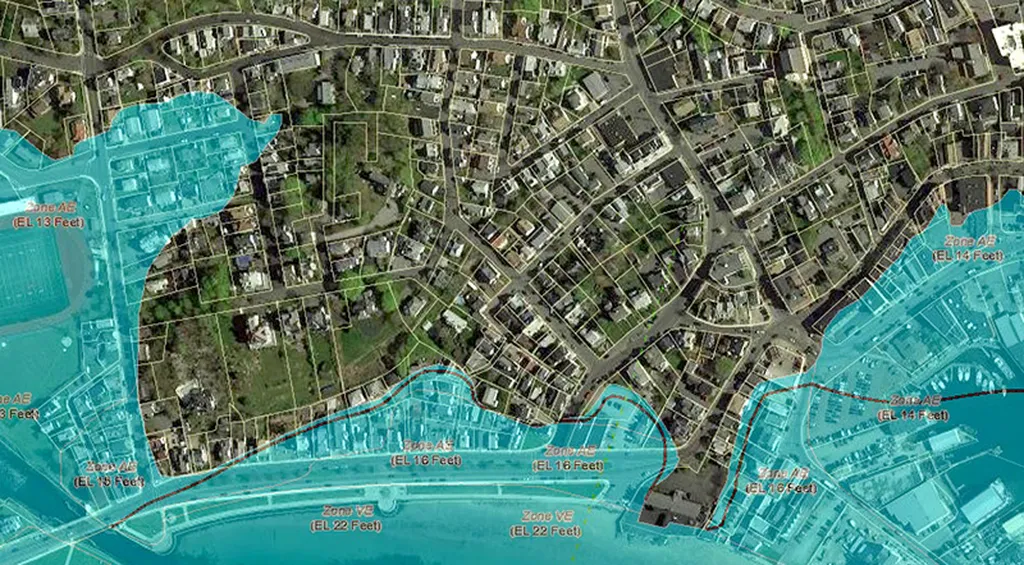
In the heart of Gloucester City, New Jersey, a groundbreaking study is challenging long-held assumptions about flood hazard assessments, with significant implications for the energy sector and urban planning. Led by S. Santamaria-Aguilar from the University of Central Florida, the research, published in the journal Natural Hazards and Earth System Sciences (which translates to Natural Hazards and Earth System Sciences in English), reveals stark discrepancies between traditional and more comprehensive approaches to understanding flood risks.
For decades, most flood hazard assessments have relied on the event-based approach, which assumes that the probability of flooding is roughly equal to the probability of flood drivers like heavy rainfall or storm surges. However, this method overlooks critical factors such as the temporal and spatial variability of these drivers and the complex processes of water propagation and interaction with topography.
Santamaria-Aguilar’s study introduces the response-based approach, which accounts for these nuances by analyzing a large number of flood events to calculate more accurate flood probabilities. The findings are eye-opening: compound events with return periods of less than 20 years can produce what are commonly referred to as 100-year flood depths in large areas of Gloucester City. This means that floods with a 5% annual exceedance probability can reach the severity previously associated with a 1% annual exceedance probability.
“The temporal and spatial characteristics of these events, such as prolonged high coastal water levels and rainfall fields with higher rainfall rates over urbanized areas, play a crucial role,” explains Santamaria-Aguilar. “These factors are often simplified or ignored in traditional models, leading to significant discrepancies in flood hazard estimates.”
The implications for the energy sector are profound. Accurate flood hazard assessments are vital for the siting, design, and operation of energy infrastructure, including power plants, transmission lines, and renewable energy installations. Underestimating flood risks can lead to costly damages, operational disruptions, and even catastrophic failures. Conversely, overestimating risks can result in unnecessary expenses and inefficiencies.
“This research underscores the need for a more nuanced understanding of flood dynamics,” says an industry expert familiar with the study. “For the energy sector, this means investing in advanced modeling techniques and data collection methods to better predict and mitigate flood risks.”
The study’s findings suggest that future flood hazard assessments should incorporate the temporal and spatial variabilities of flood drivers to produce more robust estimates. This shift could lead to the development of more resilient infrastructure, better land-use planning, and more effective emergency response strategies.
As the energy sector grapples with the challenges of climate change and increasing weather extremes, this research offers a timely reminder of the importance of accurate risk assessments. By embracing more comprehensive approaches like the response-based method, stakeholders can make more informed decisions, ultimately safeguarding both their investments and the communities they serve.
In the words of Santamaria-Aguilar, “The goal is to move beyond simplistic models and embrace the complexity of natural processes. Only then can we truly understand and mitigate the risks posed by floods.”