
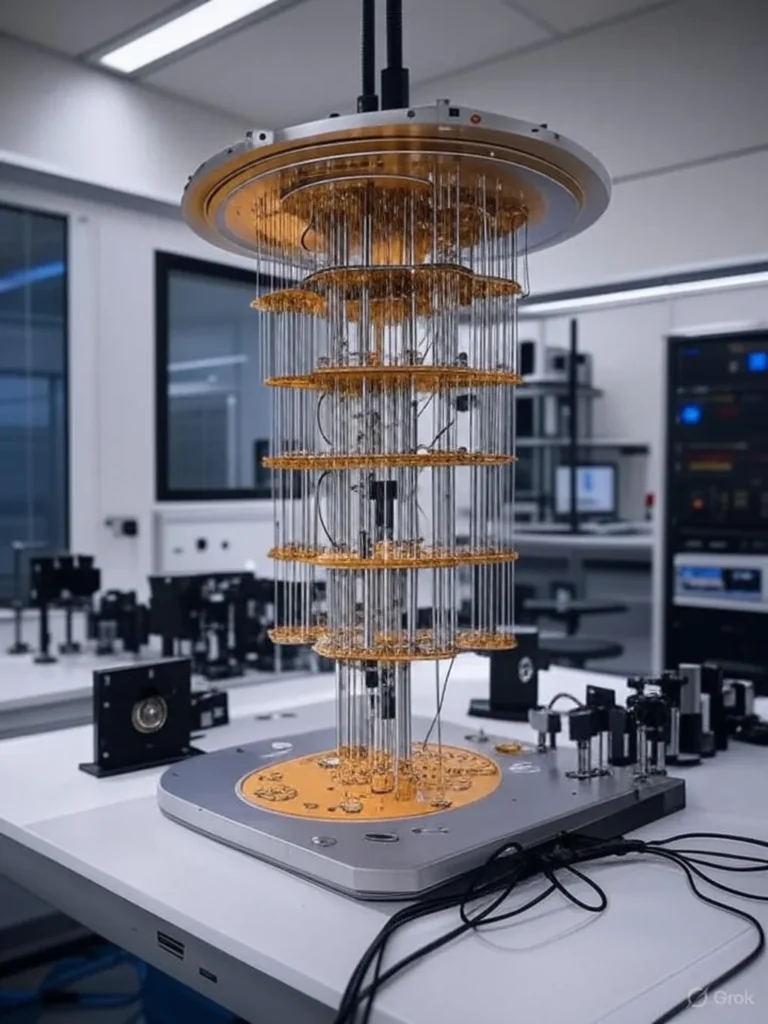
In a significant stride towards practical quantum computing, researchers have unveiled a novel architecture that could make fault-tolerant quantum computation a reality over optically networked trapped-ion modules. This breakthrough, published in the IEEE Transactions on Quantum Engineering (which translates to the IEEE Transactions on Quantum Engineering), could have profound implications for various sectors, including energy, by enabling more robust and efficient quantum computations.
The study, led by Nitish Kumar Chandra from the University of Pittsburgh’s Department of Informatics and Networked Systems, focuses on creating a topologically protected Raussendorf–Harrington–Goyal (RHG) lattice cluster state. This state is known for its resilience against errors, making it a strong candidate for fault-tolerant quantum computation.
Chandra and his team employ a bilayered implementation, where the number of modules matches the number of sites in two lattice layers. “By leveraging spatial and temporal multiplexing, we ensure that the remote entanglement generation rates surpass the bond-failure tolerance threshold of the RHG lattice,” Chandra explains. This means that the system can maintain its quantum properties even when some parts fail, a crucial feature for practical applications.
The architecture uses photonic interactions to generate remote entanglement between modules and local Coulomb interactions for intra-modular entangling gates. This dual approach allows for more efficient and reliable quantum computations. “For large distances between modules, we incorporate quantum repeaters between sites and analyze the benefits in terms of cumulative resource requirements,” Chandra adds. Quantum repeaters help to extend the range of quantum communication, which is essential for scaling up the system.
The research also derives and analyzes a qubit noise-tolerance threshold inequality for the RHG lattice generation. This accounts for various noise sources, including depolarizing noise from photonically-mediated remote entanglement generation, imperfect gates and measurements, and memory decoherence over time. By understanding these noise sources, the team can better design systems that are robust against errors.
The implications of this research are far-reaching. In the energy sector, for instance, quantum computers could optimize complex systems, such as power grids, making them more efficient and reliable. They could also accelerate the discovery of new materials for renewable energy technologies. “Our work underscores the hardware and channel threshold requirements to realize distributed fault-tolerant measurement-based quantum computation in a leading qubit platform today: trapped ions,” Chandra states.
This research not only advances the field of quantum computing but also brings us closer to practical, large-scale quantum applications. As we continue to explore and develop these technologies, the potential for transformative impacts across various industries grows ever more promising.