
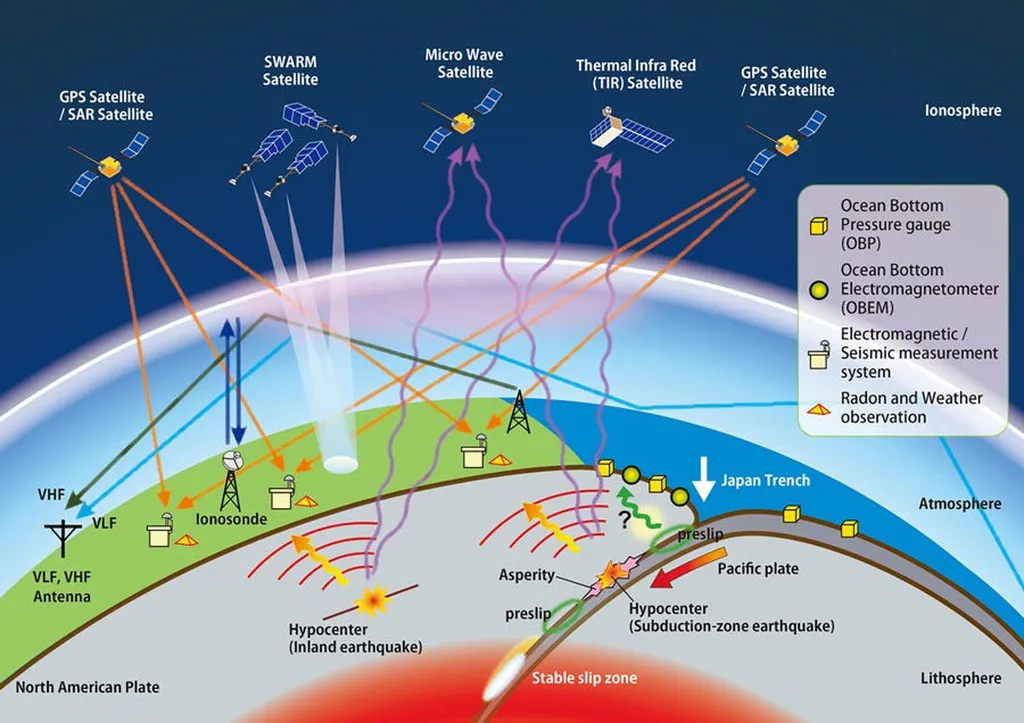
In the quest to better understand and predict earthquakes, researchers have turned to the skies, leveraging satellite technology to detect subtle shifts in the Earth’s surface that may precede seismic events. A recent study published in the International Archives of the Photogrammetry, Remote Sensing and Spatial Information Sciences, which translates to The International Archives of the Photogrammetry, Remote Sensing and Spatial Information Sciences, has shed new light on this promising approach, with significant implications for the energy sector.
Led by R. Eskandari from the Department of Architecture, Built Environment and Construction Engineering at Politecnico di Milano, the research focused on the 2021 Mw 6.3 Thessaly earthquake in northern Greece. The team utilized the European Ground Motion Service (EGMS) to analyze satellite-based Interferometric Synthetic Aperture Radar (InSAR) data, which provides high-resolution measurements of ground deformation over time.
The study revealed a clear acceleration in both vertical and horizontal ground movement within a 15-20 km radius around the epicenter, specifically in the year leading up to the earthquake. “These changes are interpreted as potential indicators of fault zone activation, possibly related to aseismic slip or fluid-driven processes,” Eskandari explained. This finding suggests that satellite data could play a crucial role in identifying precursory signals of seismic activity.
For the energy sector, the implications are substantial. Oil, gas, and geothermal operations often occur in seismically active regions, where induced seismicity can pose risks to infrastructure and personnel. By integrating InSAR data into their monitoring systems, energy companies could gain valuable insights into ground stability and potential seismic hazards. “This research reinforces the role of multi-temporal InSAR techniques in seismic hazard research and early warning strategies,” Eskandari noted.
The use of freely accessible datasets like EGMS makes this technology more accessible and cost-effective for commercial applications. As the energy sector increasingly embraces digital transformation and data-driven decision-making, the integration of satellite-based ground deformation monitoring could become a standard practice in risk management and operational planning.
The study’s findings also open new avenues for future research. By refining the techniques used to analyze InSAR data, scientists may be able to detect even more subtle precursory signals, improving the accuracy and reliability of earthquake predictions. This could lead to the development of advanced early warning systems that mitigate risks and enhance safety for energy operations in seismically active areas.
As the energy sector continues to evolve, the integration of cutting-edge technologies like InSAR data analysis will be crucial in navigating the complexities of seismic hazards. By staying at the forefront of these advancements, energy companies can better protect their assets, ensure the safety of their operations, and contribute to the broader goal of understanding and mitigating earthquake risks.