
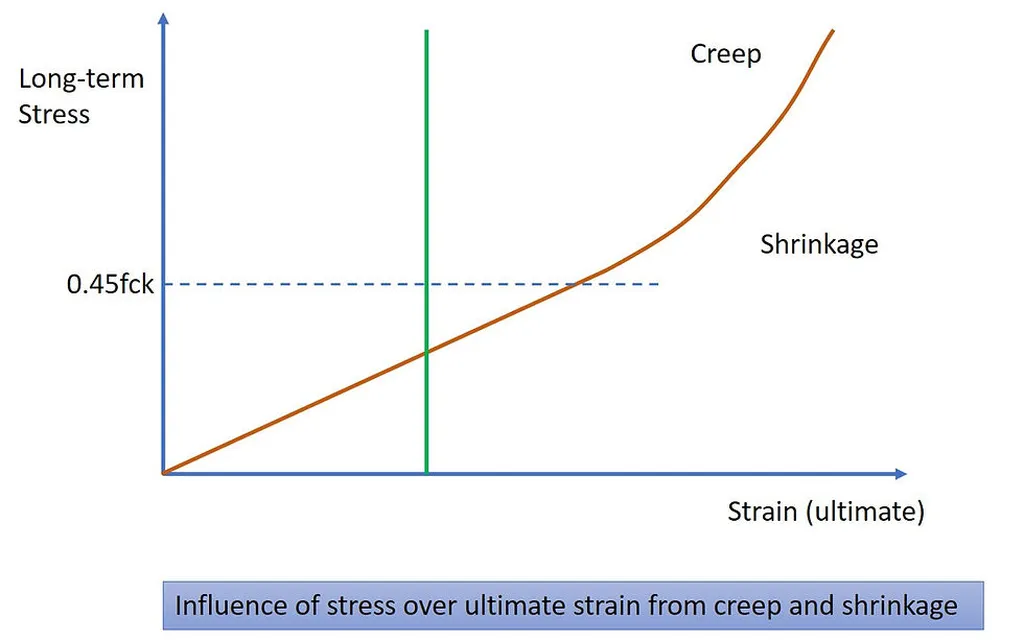
In the world of structural engineering, time is more than just a measure of progress—it’s a force that can significantly alter the behavior of concrete structures. A recent study published in the Brazilian Journal of Structural and Material Engineering (Revista IBRACON de Estruturas e Materiais) sheds light on how creep and shrinkage, time-dependent phenomena, can lead to unexpected deformations in reinforced concrete beams and frames, even without an increase in load. This research, led by Amilton Rodrigues da Silva, offers a nuanced look at how these effects can be modeled and managed, with potential implications for the energy sector and beyond.
Creep and shrinkage are familiar concepts to structural engineers, but their effects are often simplified or overlooked in design codes. Da Silva’s work challenges this approach, demonstrating that simplified formulations can lead to both overly conservative and unsafe results. “The analysis of shrinkage and creep effects through simplified formulations can lead to significant discrepancies,” da Silva notes. His research employs the finite element method to model these phenomena with greater precision, using an iterative incremental process to establish equilibrium configurations over time.
The study focuses on the use of bar finite elements based on Euler-Bernoulli beam theory to model beams and frames. By transforming additional deformations due to creep and shrinkage into forces, da Silva’s method establishes a new equilibrium configuration at each step of the incremental analysis. This approach not only validates the presented formulation but also highlights the limitations of current design codes.
For the energy sector, where large-scale concrete structures are common, this research could have significant commercial impacts. Accurate modeling of time-dependent phenomena can lead to more efficient designs, reducing material costs and improving structural performance. “Understanding these effects is crucial for the long-term integrity of our infrastructure,” da Silva explains. By adopting more sophisticated analysis techniques, engineers can ensure that structures remain safe and serviceable over their entire lifespan.
The study’s findings are particularly relevant for the design of energy infrastructure, such as wind turbine foundations and nuclear power plant containment structures, where precise modeling of long-term behavior is essential. As the energy sector continues to evolve, the need for accurate and reliable structural analysis will only grow. Da Silva’s research provides a valuable tool for meeting this challenge, offering a more comprehensive understanding of the time-dependent behavior of concrete structures.
In conclusion, da Silva’s work represents a significant step forward in the analysis of creep and shrinkage effects in reinforced concrete structures. By validating a more precise modeling approach, this research paves the way for improved design practices and enhanced structural performance. As the energy sector continues to push the boundaries of engineering, the insights gained from this study will be invaluable in ensuring the safety and efficiency of our infrastructure.