
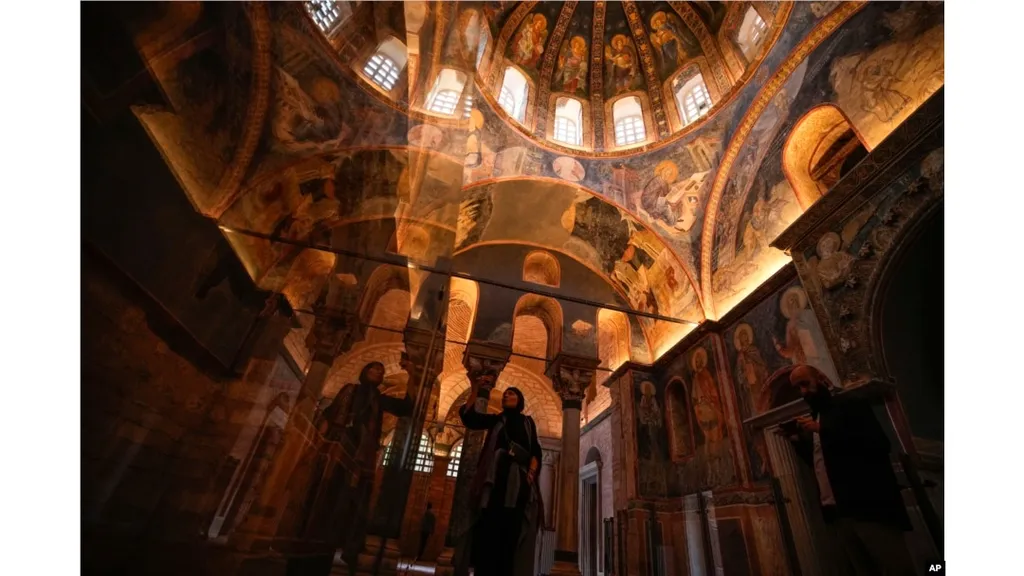
In the heart of Akçaabat, Trabzon, Türkiye, an ancient church stands as a testament to centuries of history. The Saint Michael Church, with its medieval core and 19th-century additions, has recently been the subject of cutting-edge digital documentation, thanks to the work of B. A. Atasoy from Karadeniz Technical University’s Department of Geomatics Engineering. This project, published in ‘The International Archives of the Photogrammetry, Remote Sensing and Spatial Information Sciences’ (translated to English as ‘International Archives of Photogrammetry, Remote Sensing and Spatial Information Sciences’), is not just about preserving a historical monument; it’s about revolutionizing how we interact with and understand our cultural heritage.
Atasoy and his team employed high-resolution UAV photogrammetry to capture 178 aerial images of the church, creating a detailed 3D model optimized for online delivery. This model, exported in glTF format and rendered through a Three.js viewer, allows for an unprecedented level of detail and accessibility. “The workflow allows close inspection of stonework and ornament while maintaining a faithful representation of the building fabric,” Atasoy explains. This level of detail is crucial for conservation efforts and art-historical analysis, but it also opens up new possibilities for commercial applications, particularly in the energy sector.
Imagine being able to virtually inspect the structural integrity of historical buildings before undertaking energy-efficient renovations. This technology could significantly reduce the risk and cost associated with such projects. Moreover, the ability to create detailed 3D models of historical sites could revolutionize the way energy companies approach heritage sites, ensuring that conservation efforts are both effective and sustainable.
The research also highlights the potential for semantic enrichment, linking model elements with interpretive notes, and scalable deployment using multi-LOD CityJSON for comparative studies. This could lead to a more comprehensive understanding of historical structures and their energy performance, paving the way for innovative solutions in the energy sector.
As Atasoy notes, “The resulting dataset and viewer serve conservation documentation, research use, and broader access to a protected monument, and they align with international aims for heritage safeguarding, including Sustainable Development Goal 11.4.” This project is a significant step forward in the field of cultural heritage preservation and has the potential to shape future developments in the energy sector. By leveraging advanced technology, we can ensure that our historical sites are not only preserved but also utilized in innovative ways to meet modern energy challenges.