
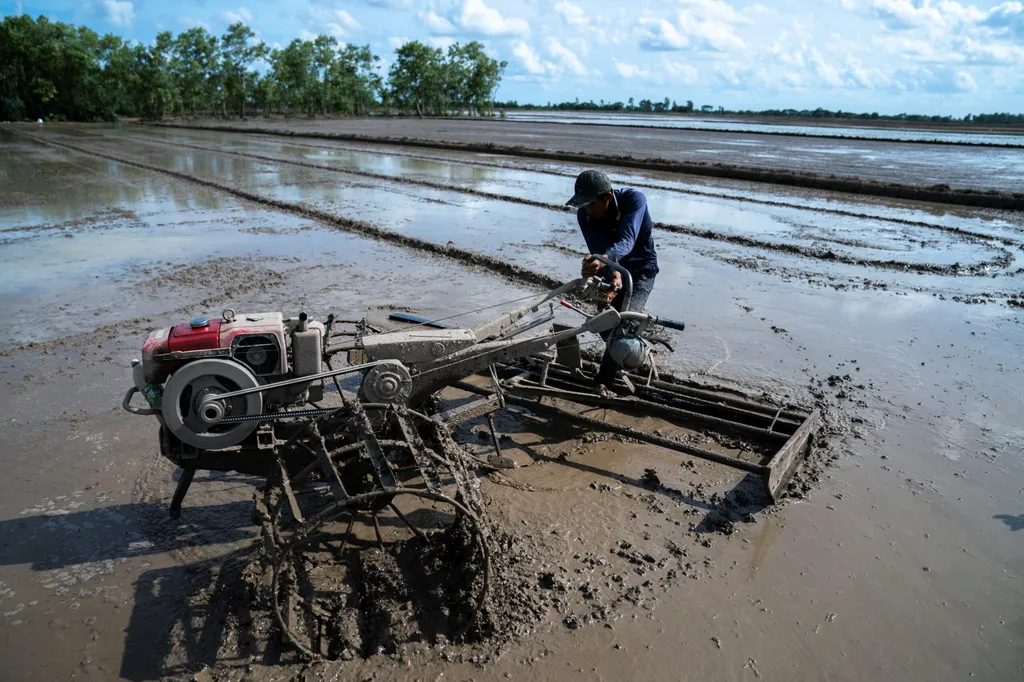
In the heart of Vietnam’s Mekong Delta, a region pivotal for agriculture and energy production, a unique interplay of resilience measures is unfolding. A recent study, led by Thanh Phuoc Ho from the Department of Geography at Ludwig Maximilians University Munich, sheds light on the intricate dynamics of flood resilience in the Vietnamese Mekong Delta (VMD), offering valuable insights for the energy sector and beyond.
The study, published in *Environmental Research Letters* (translated as *Letters on Environmental Research*), focuses on Cho Moi district in An Giang province, a representative case of flood resilience following the implementation of the South Vam Nao project. This initiative has not only improved flood resilience but also fostered coordination between local governments and citizens, enhancing farmers’ capacity to mitigate flood impacts.
At the core of this resilience lies the ‘high-dike construction,’ a central measure that has facilitated the transformation of agricultural practices. However, the study reveals that even without high dikes, farmers remain the most critical factor in sustaining resilience, regardless of government-led measures. “Farmers’ adaptive practices are indispensable,” Ho emphasizes. “They are the frontline responders to flooding, and their capacity to innovate and adapt cannot be overstated.”
The research employs Bayesian network (BN) analysis, a statistical tool that examines the interrelationships among various flood resilience measures. The BN inference test, assuming all measures perform at 100% efficiency, illustrates that the current system configuration performs strongly overall. However, the study also highlights the need to redesign the height of the high-dike system to mitigate landslide risks and address environmental problems such as nutrient-rich alluvium loss and soil compaction.
For the energy sector, understanding these dynamics is crucial. The Mekong Delta is not only a vital agricultural region but also a significant energy producer. Flood resilience measures can directly impact energy infrastructure, from hydropower plants to agricultural energy demand. By comprehending the interactions among resilience measures, energy companies can better prepare for and mitigate flood impacts, ensuring a more stable energy supply.
Moreover, the study introduces an innovative framework for flood resilience assessment, helping governments and industries understand their water management systems and identify necessary improvements. “This framework can be applied to other regions facing similar challenges,” Ho notes. “It’s a tool for proactive planning and adaptive management.”
The research underscores the importance of integrating engineering measures with adaptive practices, a lesson that resonates beyond the Mekong Delta. As climate change intensifies, the need for robust flood resilience strategies becomes ever more pressing. This study not only advances our understanding of flood resilience but also provides a roadmap for future developments in the field, shaping policies and practices that can safeguard both agricultural and energy sectors.
In an era of increasing climate variability, the insights from this study are invaluable. They remind us that resilience is not just about building higher dikes or implementing advanced technologies but also about empowering communities and fostering adaptive practices. As we navigate the challenges of a changing climate, these lessons will be instrumental in building a more resilient future.