
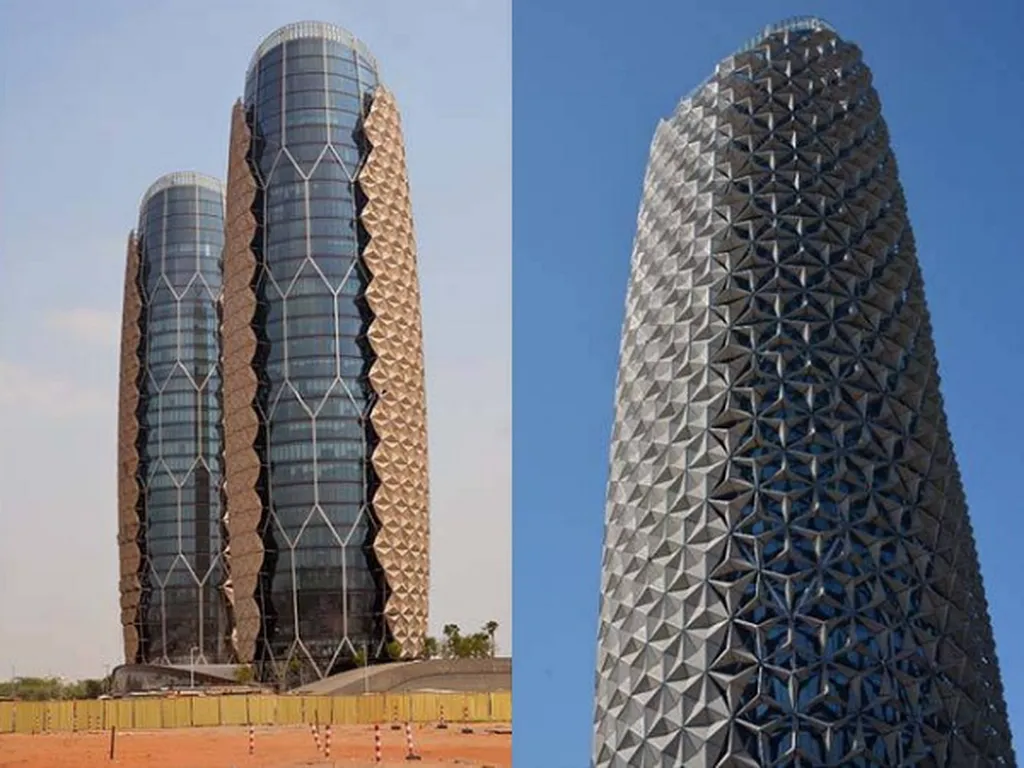
In the quest to meet the European Union’s ambitious climate-neutral goals, researchers are turning to innovative building technologies, and a recent study published in the journal *Frontiers in Built Environment* (translated from German as *Frontiers in the Built Environment*) is making waves in the construction industry. The research, led by Maria Matheou of the Institute for Lightweight Structures and Conceptual Design at the University of Stuttgart, focuses on adaptive, high-performance façade systems that could significantly reduce energy consumption in buildings.
Matheou and her team have designed and prototyped three distinct adaptive façade systems, each with unique capabilities to control, redirect, or harvest solar radiation. These systems are not just about aesthetics; they are engineered to enhance energy efficiency and occupant comfort by minimizing reliance on traditional heating, cooling, and artificial lighting systems.
One of the most intriguing aspects of this research is the use of retroreflective optics in the first façade system. “This system uses a retroreflector’s geometry to redirect solar radiation back toward its source,” explains Matheou. “By doing so, it potentially reduces short-wave radiative loading near the façade, effectively cooling the building.” This innovative approach could have significant implications for the energy sector, particularly in regions with intense solar radiation.
The second system reinterprets static folding geometries into a kinetic shading system of translucent panels. This dynamic design allows for adaptive shading, which can be crucial in maintaining optimal indoor temperatures and reducing energy consumption. The third prototype introduces rectangular photovoltaic modules supported by a cable net and strut framework, facilitating solar tracking. This system not only provides shading but also generates renewable energy, making it a dual-purpose solution.
The research involved extensive simulation studies conducted for four distinct climatic conditions, using advanced software tools like Climatestudio and Ladybug plug-ins for Grasshopper/Rhino 3D. These simulations evaluated the potential for visual comfort, daylight quality, glare, view to the outside, and solar harvesting. The outcomes were synthesized through a cross-case comparative framework, linking climate drivers, performance objectives, and actuation-feasible states.
The commercial impacts of this research are substantial. Buildings account for a significant portion of global energy consumption, and adaptive façades could play a pivotal role in reducing this footprint. By integrating these advanced systems into new and existing buildings, the energy sector could see a marked decrease in demand for heating, cooling, and artificial lighting, leading to lower energy bills and a reduced carbon footprint.
Matheou’s work is not just about creating innovative designs; it’s about establishing transferable design principles that can be applied across various typologies. “The novelty lies in extending retroreflective optics into a kinetically reconfigurable façade for controlled solar-radiation redirection near the façade, and extracting transferable design principles across three typologies that refer to morphology, control logic, and multi-criteria performance,” she notes.
The prototypes developed in this research provide proof-of-concept validation for the kinematic behavior of adaptive high-performance façade systems. They serve as an archival benchmark for early-stage adaptive multifunctional façade design, paving the way for future developments in the field.
As the construction industry continues to evolve, the integration of adaptive façades could become a standard practice, driven by the need for more sustainable and energy-efficient buildings. Matheou’s research is a significant step in this direction, offering a glimpse into the future of building design and its potential to transform the energy sector.