
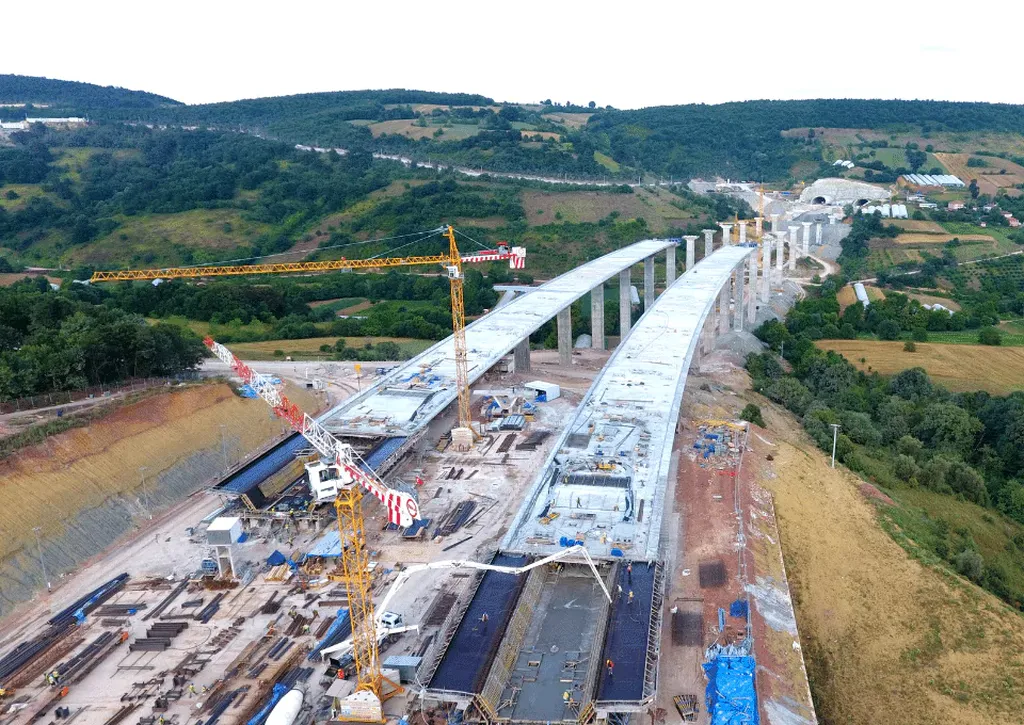
In the realm of bridge construction, precision is paramount. A new automated system developed by Ani Stefanova from the Department of Applied Geodesy at the University of Architecture, Civil Engineering and Geodesy in Sofia, Bulgaria, is set to revolutionize the way we build bridge superstructures using the cantilever method. This innovative system, detailed in a recent publication in *Facta Universitatis. Series: Architecture and Civil Engineering* (which translates to *Facts of the University. Series: Architecture and Civil Engineering*), promises to enhance accuracy, efficiency, and safety in bridge construction, with significant implications for the energy sector.
The automated system comprises two key modules: an observation module and an assembly module. The observation module utilizes a robotic total station and a portable laptop-tablet equipped with specialized software. This setup allows for precise geodetic measurements to monitor the spatial status of the cantilever facility and the constructed bridge segments. The assembly module, connected via a radio interface, receives correction data from the observation module. This data is then used to adjust the construction process in real-time, ensuring that each segment of the bridge is built to exact specifications.
“This system not only improves the accuracy of geodetic control but also significantly speeds up the construction process,” explains Stefanova. “By automating the measurement and correction process, we can reduce human error and enhance the overall efficiency of bridge construction.”
The implications for the energy sector are substantial. Bridges are critical infrastructure for transporting energy resources, and any delays or inaccuracies in their construction can have cascading effects on energy distribution networks. By ensuring that bridges are built to precise specifications, this automated system can help prevent costly delays and maintenance issues, ultimately leading to more reliable and efficient energy transportation.
Moreover, the system’s ability to provide fast and reliable data preparation for spatial orientation and automated preparation of executive documentation can streamline the entire construction process. This not only saves time and resources but also enhances the safety of the construction site, as workers can rely on precise, real-time data to guide their activities.
As the energy sector continues to evolve, the demand for robust and efficient infrastructure will only grow. Stefanova’s research offers a glimpse into the future of bridge construction, where automation and precision work hand in hand to create safer, more reliable, and more efficient infrastructure. “The development of such high-precision geodetic tools and means of communication is a significant step forward in the field of bridge construction,” says Stefanova. “It sets a new standard for accuracy and efficiency, paving the way for future advancements in the industry.”
In conclusion, Stefanova’s automated system for geodetic control represents a significant leap forward in bridge construction technology. Its potential to enhance precision, efficiency, and safety makes it a valuable tool for the energy sector and beyond. As the industry continues to embrace automation and advanced technologies, this system could well become a cornerstone of modern bridge construction, shaping the future of infrastructure development.