
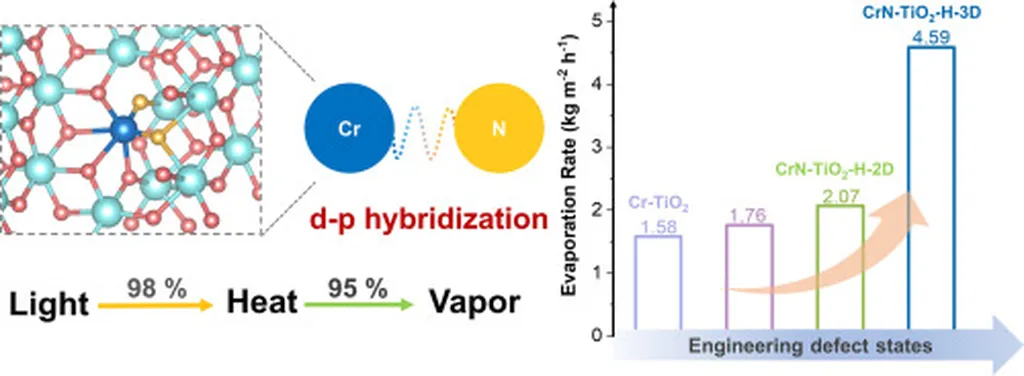
In the quest for more efficient and cost-effective photocatalytic materials, a team of researchers led by Dreenan Shea from Dalhousie University’s Department of Chemistry has made a significant stride. Their work, published in Nano Select (translated as “Nano Choice”), focuses on the enhancement of titanium dioxide (TiO2) photocatalysis using group 4 metal nitrides, offering promising implications for the energy sector.
Traditional photocatalysis has long relied on TiO2 due to its low cost, stability, and non-toxicity. However, its limited solar absorption has been a persistent challenge. “We’ve known for some time that plasmonic materials can extend light absorption into the visible and near-infrared range, but the mechanisms behind this enhancement have been less clear,” Shea explains.
The study synthesizes composites of titanium nitride (TiN), zirconium nitride (ZrN), and hafnium nitride (HfN) with commercial P25 TiO2. The results are striking. Under illumination, the 1 wt% ZrN/TiO2 composite achieved over 99% degradation of Rhodamine B dye in just 50 minutes, outperforming TiN and HfN, which required a 10 wt% loading for similar results.
What sets this research apart is its detailed assessment of the enhancement pathways. By analyzing reaction temperature profiles and degradation kinetics under different light intensities, the team found that hot carrier effects dominate in TiN/TiO2 and ZrN/TiO2 systems, while photothermal effects play a larger role in HfN/TiO2 composites. “This highlights the distinct mechanisms by which plasmonic nitrides enhance photocatalytic efficiency,” Shea notes.
The commercial implications for the energy sector are substantial. Enhanced photocatalytic materials can lead to more efficient solar energy conversion, improved water treatment processes, and advanced air purification systems. “Understanding these mechanisms is crucial for designing next-generation photocatalytic materials that are not only efficient but also cost-effective,” Shea adds.
This research opens new avenues for developing high-performance photocatalytic materials, potentially revolutionizing various industries. As the world continues to seek sustainable and efficient energy solutions, the insights from this study could play a pivotal role in shaping future developments in the field.