
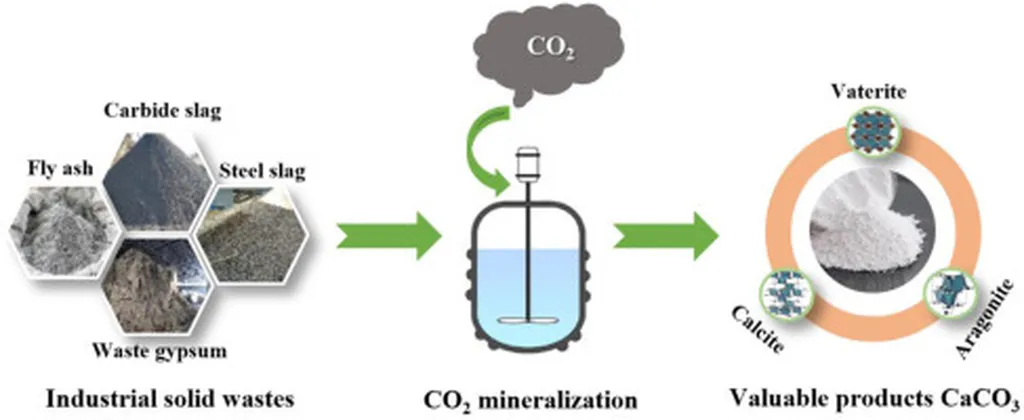
In a significant stride towards combating climate change, researchers have developed a novel method for accelerating CO2 mineralization, paving the way for innovative applications in the construction industry. The study, led by Prince Allah from the Fibre and Particle Engineering Research Unit at the University of Oulu in Finland, introduces a technique that could revolutionize carbon capture and utilization technologies.
The research, published in the journal *Carbon Capture Science & Technology* (translated from the original title), focuses on the use of wollastonite, a calcium silicate mineral, to capture CO2 efficiently. The team granulated wollastonite powder with polyvinyl alcohol and potassium persulfate, creating porous granules that significantly enhance CO2 diffusion and minimize passivation by carbonate precipitation.
“Our findings demonstrate that incorporating 20% persulfate into the granulation process results in highly porous granules with an interconnected pore structure,” explained Allah. “This structure not only captures a substantial amount of CO2 but also prevents the formation of a passivating layer that can hinder further carbonation.”
The study revealed that granules with 20% persulfate captured up to 44% CO2 by volume, a remarkable improvement over granules with 0, 10, and 100% persulfate, which showed poor CO2 diffusion due to surface passivation. The enhanced pore structure, as analyzed using Frankel–Halsey–Hill (FHH) fractal analysis, proved crucial in facilitating CO2 diffusion and preventing passivation.
One of the most compelling aspects of this research is its potential application in the construction industry. After carbonation, the aggregates maintained high strength and lightweight properties, making them ideal for use as artificial lightweight aggregates. This innovation could lead to the development of high-volume CO2-negative construction materials, significantly reducing the carbon footprint of the building sector.
“The commercial implications of this research are vast,” said Allah. “By integrating these porous wollastonite granules into construction materials, we can create a sustainable cycle where CO2 is not only captured but also utilized in a way that benefits the environment and the economy.”
This breakthrough could shape future developments in carbon capture and utilization technologies, offering a scalable solution for large-scale CO2 capture. As the world seeks innovative ways to mitigate climate change, this research provides a promising avenue for reducing atmospheric CO2 levels while simultaneously enhancing the sustainability of the construction industry.
The study’s findings highlight the importance of interdisciplinary research in addressing global challenges. By combining materials science, chemical engineering, and environmental science, the research team has developed a solution that could have far-reaching impacts on the energy and construction sectors. As the world continues to grapple with the effects of climate change, such innovations offer hope for a more sustainable future.