
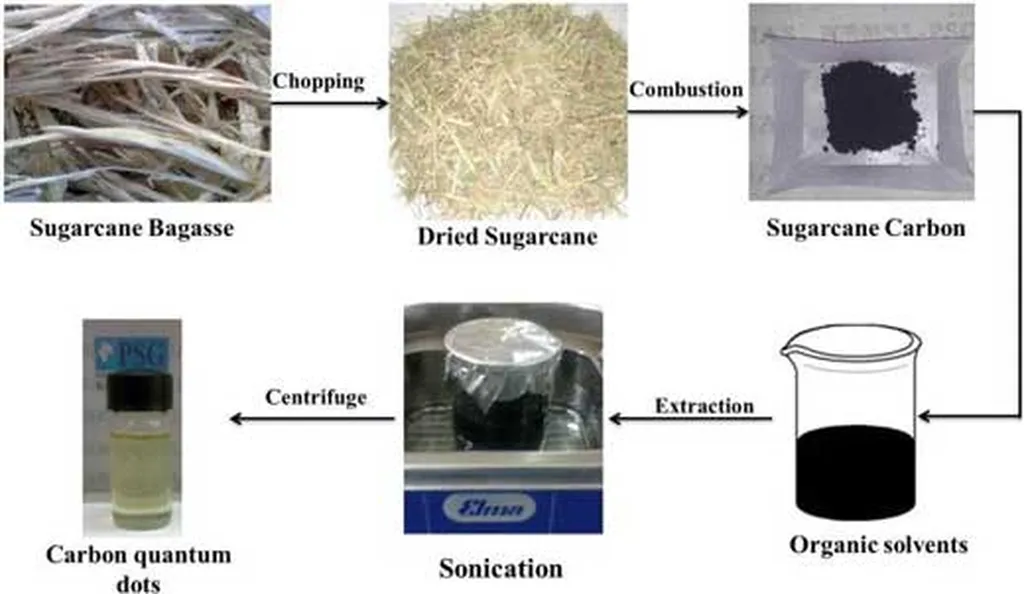
In a groundbreaking study published in the journal *Nano Select* (translated to English as “Nano Choice”), researchers have unveiled a novel approach to synthesizing carbon quantum dots (CQDs) from organic waste, potentially revolutionizing the energy sector. The research, led by Navtej Singh from the Department of Chemistry at the Indian Institute of Technology Bhilai, Durg, Chhattisgarh, India, explores the intricate relationship between the microstructural parameters of CQDs and their optical properties, derived from two distinct waste precursors: banana peels and human hair.
Carbon quantum dots, known for their versatility, have garnered significant attention in both fundamental and applied research. Singh’s study marks a significant stride towards sustainable material utilization by transforming biomass waste into valuable nanocarbon materials. “We aimed to bridge the gap between material-level understanding and application potential,” Singh explained. “By integrating structural characterization with optical property analysis, we can better tailor CQDs for specific applications.”
The research meticulously compares CQDs derived from banana peels (B-CQDs) and human hair (H-CQDs), establishing a direct link between the choice of precursor and the resulting properties of the CQDs. Through advanced techniques such as high-resolution transmission electron microscopy (HR-TEM) and selected area electron diffraction (SAED), the team estimated various microstructural parameters and explored plausible lattice specifications for CQDs.
One of the most compelling aspects of this study is its thorough analysis of the optical properties of the CQDs, including photoluminescence (PL) and time-resolved photoluminescence (TRPL) lifetime of excitons. The researchers highlighted the impact of nanoscale lattice distortions on the optical behavior of the CQDs, presenting a comprehensive correlation between structural characteristics and photophysical response.
The implications of this research for the energy sector are profound. By understanding how different precursors affect the properties of CQDs, scientists can develop more efficient and sustainable materials for applications such as photocatalysis and optoelectronics. “This study establishes a direct link between precursor selection, microstructural characteristics, and the photophysical response of waste-derived CQDs, highlighting their tunability for targeted applications,” Singh noted.
The study also delves into the photocatalyzed degradation of methylene blue (MB) dye, demonstrating the practical applications of these waste-derived CQDs. The statistical interpretation of TEM-SAED outcomes further validates the calculated microstructural parameters, providing a robust foundation for future research.
As the world seeks sustainable solutions to energy challenges, this research offers a promising avenue for harnessing the potential of organic waste. By transforming everyday waste into high-value nanomaterials, Singh and his team are paving the way for a more sustainable and efficient energy future. The findings published in *Nano Select* not only advance our understanding of CQDs but also open new possibilities for their application in the energy sector, making it a significant milestone in the field of sustainable materials science.