
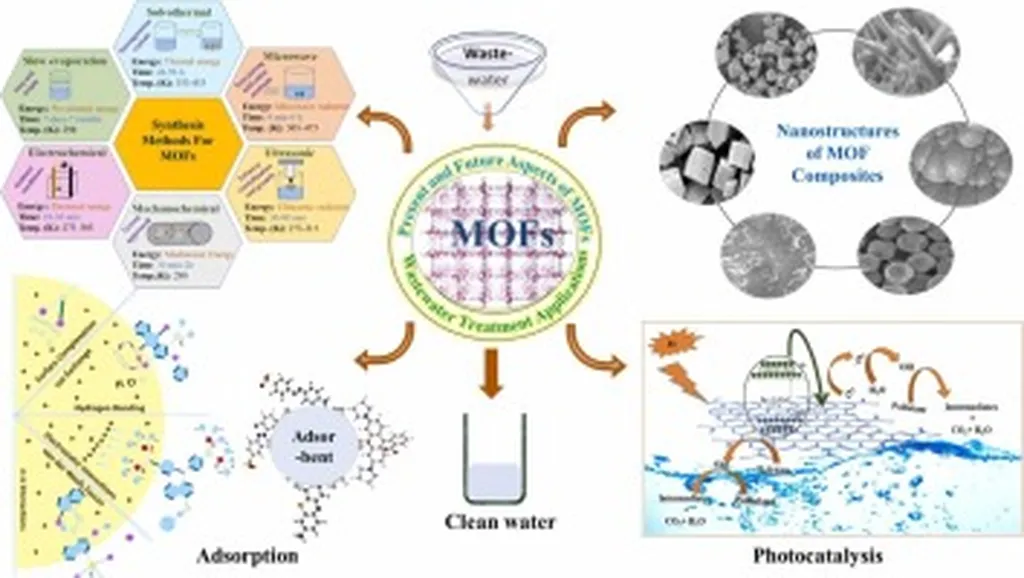
In the quest for more efficient and sustainable water treatment solutions, a team of researchers led by Amir Hossein Hamzeh from the School of Chemistry at Damghan University in Iran has made a significant breakthrough. Their study, published in the Journal of Science: Advanced Materials and Devices (known in English as the Journal of Science: Advanced Materials and Devices), focuses on enhancing poly(vinyl chloride) (PVC) ultrafiltration membranes with amino-functionalized MIL-101–NH2 (Al/Cr) metal–organic frameworks (MOFs). This innovation could have profound implications for the energy sector, particularly in wastewater treatment and resource recovery.
The research team employed the phase inversion method to create these advanced membranes, which were then characterized using various techniques such as FTIR, SEM, AFM, and contact angle measurements. The incorporation of MOFs into the PVC membranes significantly improved their hydrophilicity, porosity, and water uptake. Notably, the M2 (Cr) and M2 (Al) composites exhibited the optimal balance of these properties, with porosity reaching up to 85% and water uptake nearly 80%.
“This enhancement in membrane performance is a game-changer,” said Hamzeh. “The increased porosity and hydrophilicity translate into a marked improvement in pure water flux, which is crucial for efficient water treatment processes.”
The optimized membranes demonstrated a pure water flux of about 534.7 L m−2 h−1 for M2 (Cr) and 526.2 L m−2 h−1 for M2 (Al), compared to just 276.7 L m−2 h−1 for the pristine PVC membrane. This significant improvement can be attributed to the introduction of hydrophilic –NH2 groups and interconnected pores, which enhance the membrane’s ability to filter water efficiently.
Performance tests revealed that the optimized membranes effectively removed humic acid (≈70–80%), methyl orange (≈29%), and methylene blue (≈47%) through a combination of size exclusion and electrostatic interactions. Additionally, these membranes exhibited enhanced antifouling behavior, with flux recovery ratios (FRR) of approximately 51–52% for the best-performing membranes, indicating improved cleaning efficiency compared to pristine PVC.
The antibacterial evaluation using the Kirby–Bauer disk diffusion method showed that MIL-101–NH2(Al) membranes displayed broader antibacterial activity against E. coli, S. aureus, and S. enteritidis, while MIL-101–NH2(Cr) showed selective activity mainly against E. coli and B. subtilis. This dual functionality of dye removal and antibacterial activity makes these membranes particularly attractive for applications in wastewater treatment and other industrial processes.
The implications of this research extend beyond water treatment. In the energy sector, efficient water treatment technologies are essential for processes such as cooling, steam generation, and resource recovery. The enhanced performance of these membranes could lead to more sustainable and cost-effective operations, reducing the environmental impact of industrial activities.
“This research opens up new possibilities for the development of advanced materials in water treatment and beyond,” Hamzeh noted. “The combination of improved filtration efficiency and antibacterial properties makes these membranes a promising solution for various industrial applications.”
As the demand for clean water and sustainable practices continues to grow, innovations like these are crucial. The study published in the Journal of Science: Advanced Materials and Devices not only advances our understanding of membrane technology but also paves the way for future developments in the field. With further research and development, these enhanced membranes could become a standard in water treatment, contributing to a more sustainable and efficient future for the energy sector and beyond.