
In the realm of highway infrastructure, maintaining the vast network of asphalt pavements is a monumental task, often fraught with complex decisions and unpredictable risks. Enter Jiuda Huang, a researcher from the National Engineering Research Center of Advanced Road Materials, who has developed a groundbreaking framework to optimize long-term highway maintenance planning. Published in the journal *Advances in Civil Engineering* (translated from its original Chinese title), Huang’s work promises to revolutionize how we approach pavement maintenance, with significant implications for the energy sector and beyond.
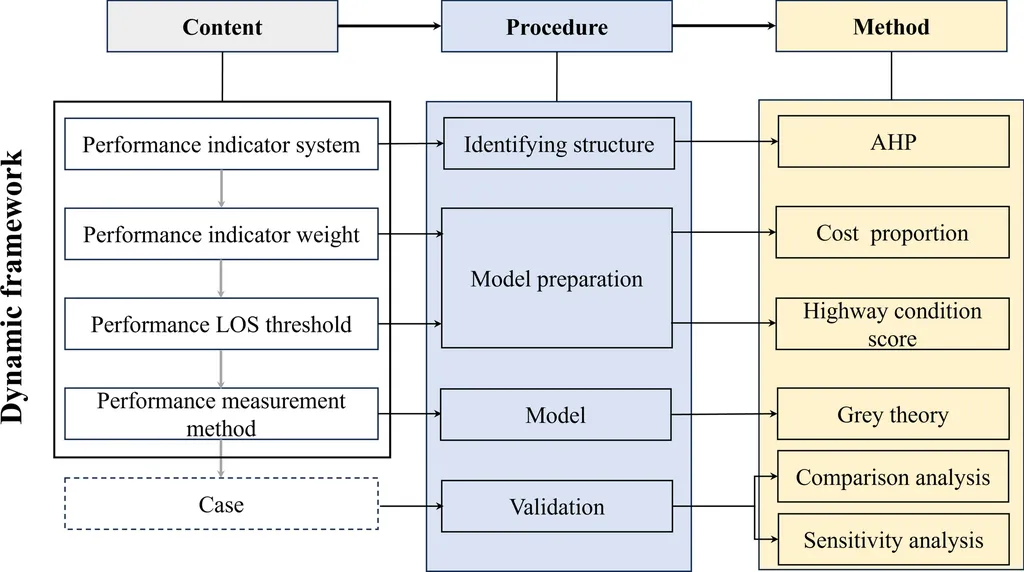
Huang’s innovative framework integrates predictive analysis, construction risks, and environmental considerations to address the challenges of inadequate project benefits, complex decision-making risks, and inefficient optimization. “The goal is to create a more holistic approach to maintenance planning,” Huang explains. “By considering multiple factors simultaneously, we can identify the most beneficial strategies over the long term.”
The framework begins with a two-parameter prediction model that forecasts the condition of pavements based on four key indicators: pavement condition index (PCI), rut depth index (RDI), riding quality index (RQI), and skid resistance index (SRI). Huang and his team validated this model using data from the G3 Jing Tai Expressway, achieving an impressive overall relative error of less than 3%. This high accuracy is a testament to the model’s potential for practical application.
But Huang didn’t stop there. He also developed a probabilistic risk assessment model within the Bayesian network theoretical framework, using GeNIe software to incorporate predetermined risk metrics. This model was validated using operational data from the same expressway, further demonstrating its reliability.
Perhaps the most significant aspect of Huang’s work is the extension of the traditional cost-benefit analysis model. By incorporating environmental and risk factors, he has established a novel benefit-assessment framework tailored to practical engineering needs. “This framework allows us to consider the broader impacts of our decisions,” Huang notes. “It’s not just about the immediate costs and benefits, but also about the long-term environmental and risk implications.”
To validate the feasibility of this road maintenance decision model, Huang conducted another case study involving a specific highway in Shandong Province. The results identified the optimal maintenance strategy with the highest benefits over a long period, further confirming the model’s potential.
The implications of Huang’s work are far-reaching. For the energy sector, which relies heavily on efficient transportation networks, this framework could lead to more effective maintenance planning, reducing downtime and improving safety. Moreover, by considering environmental factors, it could also contribute to more sustainable practices.
As we look to the future, Huang’s framework offers a promising path forward. By integrating predictive analysis, risk assessment, and environmental considerations, it provides a more comprehensive approach to highway maintenance planning. “This is just the beginning,” Huang says. “There’s still much to explore, but I believe this framework has the potential to significantly improve the way we manage our infrastructure.”
In the ever-evolving world of civil engineering, Huang’s work stands as a testament to the power of innovation. As published in *Advances in Civil Engineering* (进展), it serves as a beacon for future developments, guiding us towards a more efficient, sustainable, and safe infrastructure network.