
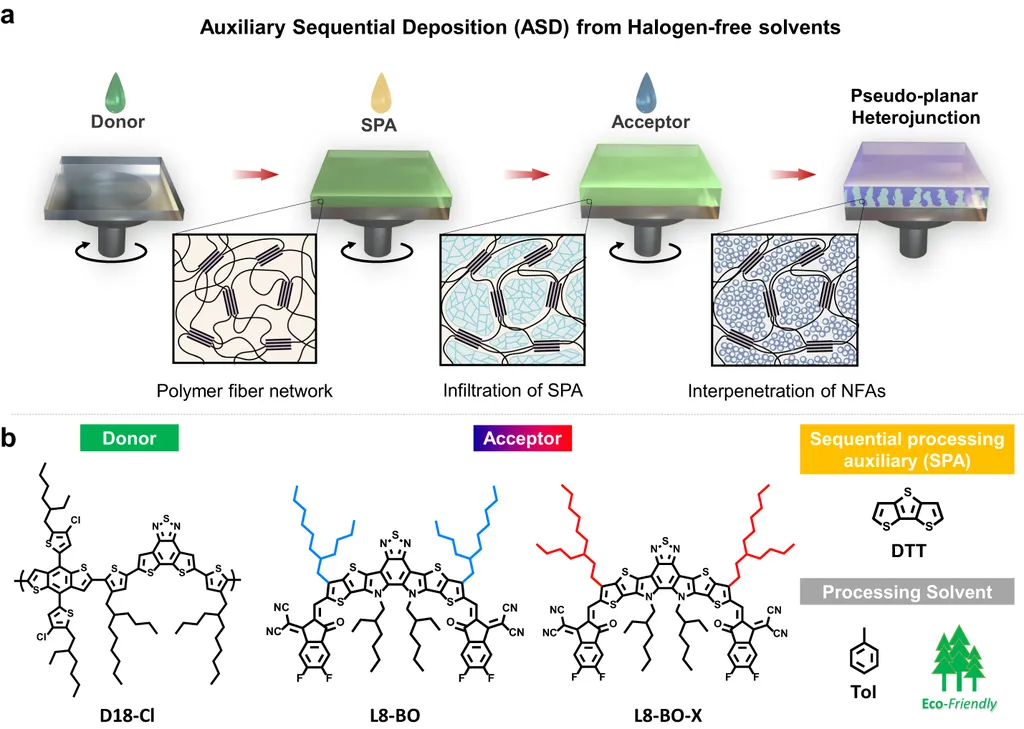
In the quest for more efficient and stable organic solar cells, researchers have been exploring various strategies to fine-tune the morphology of the active layer, where the magic of energy conversion happens. A recent study published in *JPhys Materials* (Journal of Physics Materials) by Leticia P Christopholi from the Department of Engineering and Physics at Karlstad University in Sweden, sheds light on a promising technique called sequential deposition (SD) and its impact on the vertical distribution and molecular orientation of materials within these solar cells.
Organic solar cells rely on a blend of donor and acceptor materials to generate electricity from sunlight. However, achieving an optimal balance between these components has been a persistent challenge. Christopholi and her team investigated how sequential deposition, a method where donor and acceptor materials are processed independently, could offer better control over the active layer’s morphology compared to the conventional one-step blend coating process.
Using advanced analytical techniques like time-of-flight secondary ion mass spectrometry (ToF-SIMS) and near edge x-ray absorption fine structure spectroscopy (NEXAFS), the researchers examined the vertical distribution and molecular orientation of the donor PM6 and acceptor Y5 in both SD and blend films. “Our results show that sequential deposition inverts the vertical distribution within the active layer,” Christopholi explained. This inversion could potentially enhance the performance of organic solar cells by optimizing the charge transport pathways.
The study also revealed that thermal annealing (TA), a common post-treatment process, helps to suppress the diffusion of the acceptor Y5 into the donor PM6 layer, further refining the active layer’s morphology. Moreover, the NEXAFS analysis demonstrated that in SD-processed samples, the acceptor Y5 retains its face-on orientation when deposited on top of PM6, despite the complexities of film formation dynamics and interfacial intermixing.
The implications of this research are significant for the energy sector, particularly in the development of more efficient and stable organic solar cells. By gaining a deeper understanding of the vertical phase separation and molecular orientation within the active layer, researchers can tailor the morphology to enhance the performance of these solar cells. “This work provides valuable insights into the fundamental processes governing the morphology of organic solar cells,” Christopholi noted. “It paves the way for the development of more efficient and stable devices, bringing us one step closer to a sustainable energy future.”
As the world continues to seek clean and renewable energy sources, advancements in organic solar cell technology hold great promise. The findings from Christopholi’s research, published in *JPhys Materials*, offer a compelling glimpse into the future of this field, highlighting the importance of understanding and controlling the intricate details of material morphology. With further research and development, sequential deposition and thermal annealing could become key strategies in the quest for more efficient and stable organic solar cells, ultimately contributing to a greener and more sustainable energy landscape.