
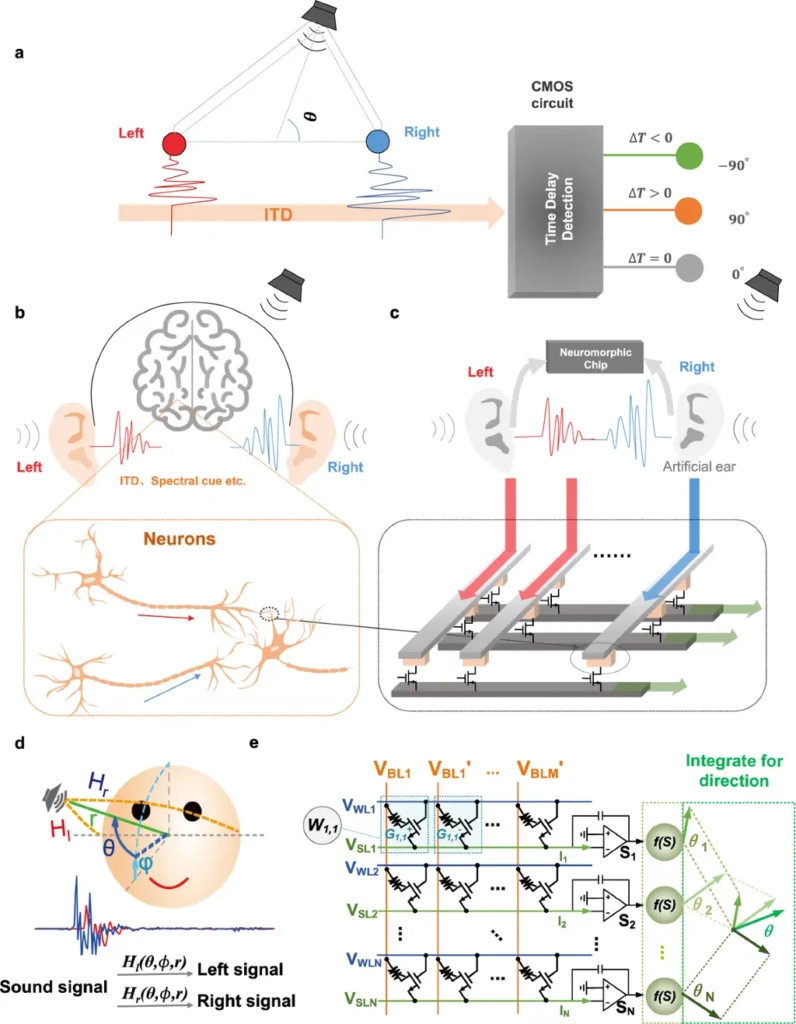
In a significant stride towards advancing brain-inspired computing, researchers have developed a versatile organic memristor that could revolutionize the way we process information and manage energy. The study, led by Sudeshna Maity from the SUNAG Laboratory at the Institute of Physics in Bhubaneswar, India, introduces a self-assembled nanowire network memristor based on copper (II) hexadecafluoro-phthalocyanine (F16CuPc). This innovation, published in *Small Science* (which translates to “Small Science” in English), promises to broaden the horizons of flexible, energy-efficient, and wearable smart electronics.
Memristors, or memory resistors, are electronic components that can remember the amount of charge that has passed through them, making them ideal for neuromorphic computing—computing that mimics the human brain. The unique aspect of this research is the tunable resistive switching (RS) behavior of the organic memristor, which can transition between digital, multilevel, and analog switching simply by modulating the compliance current (ICC).
“Our study reveals that the transition in resistive switching behavior is primarily driven by a shift from trap-limited to trap-free space charge-limited conduction as the compliance current increases,” explains Maity. This means that at low ICC, the conduction is abrupt and driven by the migration of silver cations through redox-assisted interactions, while at high ICC, the conduction becomes gradual due to π–π intermolecular interactions within the nanowires.
The implications for the energy sector are profound. Traditional computing systems consume vast amounts of energy, but neuromorphic computing, with its brain-like efficiency, could drastically reduce energy consumption. The self-assembled nanowire network memristor could be a key player in this transition, enabling the development of flexible and wearable smart electronics that are not only energy-efficient but also multifunctional.
Moreover, the controlled growth of nanowire structures via self-assembled 2D molecular stacking is a novel approach that enables multifunctionality within a pristine, nanowire network-based molecular memristive system. This could pave the way for hybrid digital-neuromorphic applications, further advancing the field of artificial intelligence and machine learning.
As we stand on the brink of a technological revolution, this research offers a glimpse into a future where computing is not just faster but also more efficient and adaptable. The work of Maity and her team is a testament to the power of innovative materials science and its potential to reshape our technological landscape. With the findings published in *Small Science*, the stage is set for further exploration and development in this exciting field.