
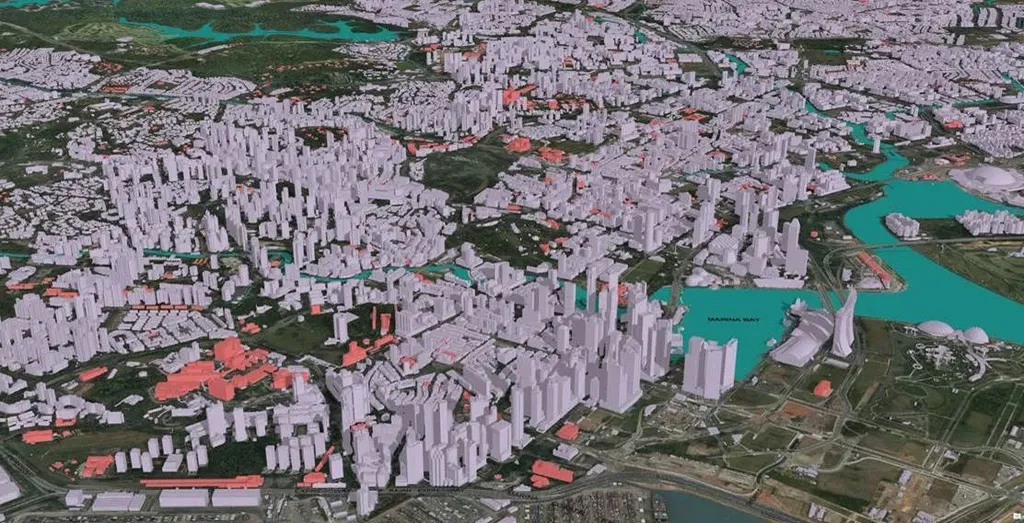
In the rapidly evolving landscape of digital transformation, a groundbreaking study led by Dr. Ruba Qudaih from the University of Suffolk’s School of Business, Art, Social Sciences and Technology is set to redefine how businesses and smart cities leverage Digital Twin (DT) technologies. Published in the International Archives of the Photogrammetry, Remote Sensing and Spatial Information Sciences (a journal that translates to The International Archives of Photogrammetry, Remote Sensing and Spatial Information Sciences in English), this research introduces a human-centered framework that integrates the metaverse with DTs, promising to revolutionize decision-making processes and enhance stakeholder engagement.
Traditional Digital Twins have long been used as static representations of physical assets, offering monitoring and predictive capabilities. However, their potential has often been limited by minimal stakeholder engagement and a narrow focus on specific sectors. Dr. Qudaih’s research addresses these limitations by proposing a metaverse-enabled DT framework that transforms these technologies into immersive, interactive platforms. “The integration of the metaverse with Digital Twins allows stakeholders to visualize and engage with multidimensional data in real time,” explains Dr. Qudaih. “This facilitates predictive analysis, scenario planning, and participatory governance, making the decision-making process more collaborative and effective.”
For the energy sector, the implications are profound. Imagine a scenario where energy companies can model and simulate entire supply chains in a virtual environment, identifying inefficiencies and optimizing operations before implementing changes in the real world. This capability not only enhances resilience and adaptability but also fosters innovation in customer experiences. “In business environments, metaverse-enhanced DTs improve supply chain modeling, aid corporate strategy formulation, and foster innovation in customer experiences,” Dr. Qudaih notes. This could lead to more sustainable and cost-effective energy solutions, ultimately benefiting both businesses and consumers.
In urban settings, the integration of IoT, Building Information Modeling (BIM), and geospatial data into engaging simulations supports smart infrastructure management, sustainability oversight, and collaborative planning. This holistic approach addresses the political, societal, legal, and technical-instrumental challenges currently affecting cities and those expected in the foreseeable future. “This framework, supported by enabling technologies and designed for inclusivity and scalability, illustrates a multidisciplinary approach to digital transformation applicable to both private and public sectors,” Dr. Qudaih explains.
The research presents a conceptual framework that links business ecosystems and smart cities through a DT layer mediated by the metaverse. This framework, supported by enabling technologies and designed for inclusivity and scalability, illustrates a multidisciplinary approach to digital transformation applicable to both private and public sectors. By addressing the current limitations of traditional DTs and leveraging the immersive capabilities of the metaverse, this research paves the way for a more collaborative, efficient, and human-centered approach to digital transformation.
As the energy sector continues to evolve, the integration of metaverse-enabled DTs could become a game-changer, driving innovation and sustainability. This research not only highlights the potential of these technologies but also provides a roadmap for their implementation, making it a crucial read for professionals in the energy sector and beyond.