
In a groundbreaking study published in *Materials Research Express*, researchers have unveiled a novel approach to enhancing the thermoelectric and photoresponse properties of zinc oxide (ZnO) thin films, potentially revolutionizing energy harvesting and photodetection technologies. Led by Neslihan Üzar from the Department of Physics at Istanbul University, the research delves into the intricate world of doped ZnO films, offering promising insights for the energy sector.
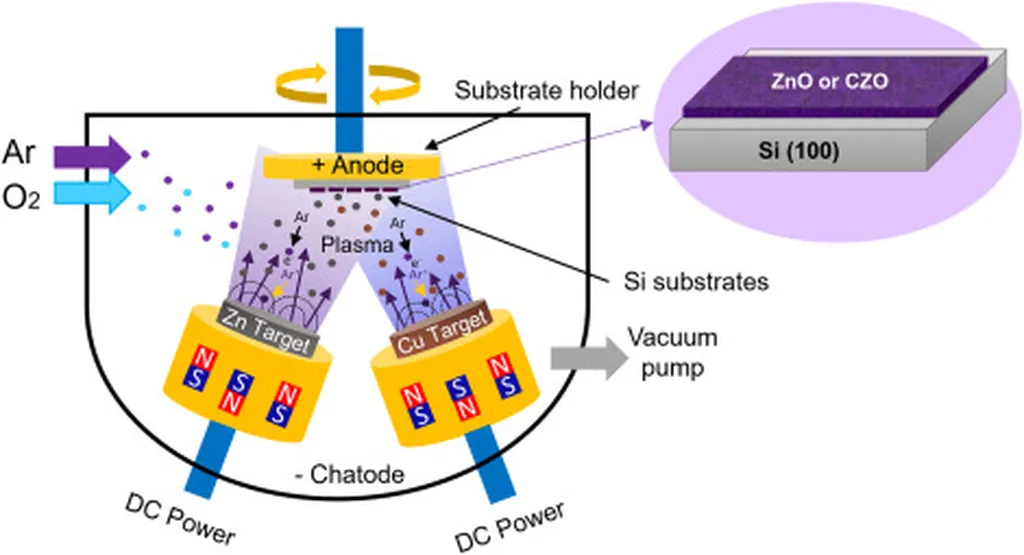
The study focused on undoped, cobalt-doped (Co-doped), and cobalt-boron co-doped (Co–B co-doped) ZnO thin films, synthesized via the sol–gel spray method. The team measured electrical resistance and thermoelectric performances under varying temperatures and illumination conditions, revealing significant improvements in both electrical conductivity and photoresponse behavior.
“Our findings demonstrate that Co–B co-doping can substantially enhance the electrical conductivity and reduce activation energy, making these films highly efficient for energy harvesting applications,” said Üzar. The researchers observed that Co doping introduced shallow donor states, yielding Seebeck coefficients up to −2250 μV/K for 1% Co-doped ZnO. However, the real breakthrough came with Co–B co-doping, which further improved electrical conductivity and reduced activation energy to approximately 0.16 eV. This resulted in a power factor of 610 μW·m^−1·K^−2 for 2% Co-1% B co-doped ZnO at 500 K, a staggering 6000 times greater than that of undoped ZnO.
The implications for the energy sector are profound. The enhanced thermoelectric properties of these co-doped ZnO films could lead to more efficient energy conversion devices, capable of operating under variable thermal and optical conditions. Additionally, the broadband photoresponse demonstrated by the 1% Co-1% B co-doped ZnO sample, with a photoresponse (Rp) greater than 90% across UV–Vis–IR spectra, opens new avenues for advanced photodetection technologies.
“This research highlights the potential of synergistic defect modulation in ZnO films, paving the way for multifunctional energy harvesting and photodetection applications,” Üzar explained. The study’s findings not only advance our understanding of thermoelectric and photoresponse mechanisms but also offer practical solutions for developing next-generation energy technologies.
As the world continues to seek sustainable and efficient energy solutions, the work of Üzar and her team represents a significant step forward. The enhanced properties of Co–B co-doped ZnO films could soon find applications in various industries, from renewable energy to advanced sensing technologies. With further research and development, these innovative materials may well shape the future of energy harvesting and photodetection, driving progress in the energy sector and beyond.
The study, titled “Temperature-dependent thermoelectric and multiband photoresponse of undoped, Co–doped and Co–B co-doped ZnO thin films,” was published in *Materials Research Express*, an open-access journal that translates to *Materials Research Express* in English. This research not only contributes to the scientific community but also holds promise for commercial applications, making it a noteworthy development in the field of materials science and energy technology.