
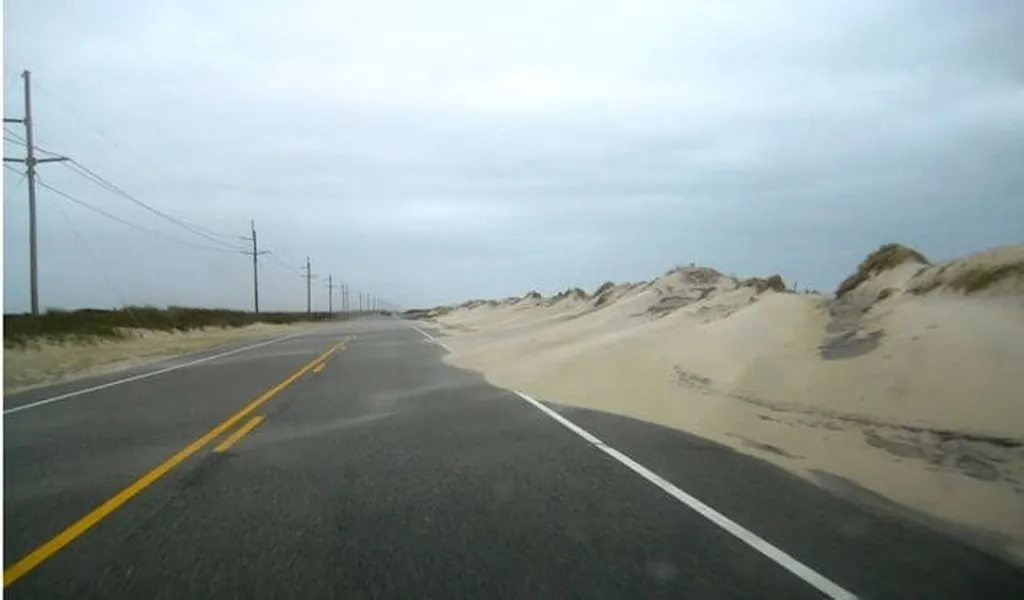
In the vast, windswept edges of deserts, where roads carve through salty, fine-grained sands, engineers face a formidable challenge: how to build durable roadways that withstand the ravages of time, temperature, and the unique geology of these regions. A recent study published in the journal *Advances in Civil Engineering* (translated from Chinese as *Advances in Civil Engineering*) sheds new light on this issue, offering insights that could reshape road construction in these delicate ecosystems.
At the heart of this research is Fuerhaiti Ainiwaer, a scientist from the School of Highway, who led a team investigating the mechanical properties of fine-grained, salinized aeolian sand. This type of sand, common in desert-edge areas, poses unique problems for road construction due to its susceptibility to temperature, moisture, and salt influences. “The fine-grained aeolian sand is more vulnerable to these factors compared to pure aeolian sand,” Ainiwaer explains. “This vulnerability can lead to roadbed diseases later on, compromising the integrity of the roads.”
To understand these challenges better, Ainiwaer and his team conducted laboratory triaxial unconsolidated undrained shear tests on sand specimens with varying freeze-thaw (FT) cycles, confining pressures, and fine contents. Their findings reveal a complex interplay between these factors. As the number of FT cycles increases, the stress–strain behavior of the sand shifts from strain softening to weak softening, particularly at higher fines content. “This means that the sand becomes less stable and more prone to deformation over time,” Ainiwaer notes.
The study also introduces the concept of shear strength deterioration, quantifying the rate at which the sand’s strength decays. The results show that shear strength declines hyperbolically with FT cycles and linearly with fines content. For instance, sand with 16% fines content experienced a 34.4% reduction in shear strength after just nine FT cycles. This deterioration is not just a theoretical concern; it has significant practical implications for road construction and maintenance.
Microstructural analysis using scanning electron microscopy revealed that fines and salt crystals initially fill the pores in the sand, providing some stability. However, under repeated FT cycles, these bonds degrade, weakening the overall structure. “This microstructural degradation is a key factor in the strength loss we observe,” Ainiwaer explains. “Understanding this process is crucial for developing more resilient road construction techniques.”
The implications of this research extend beyond road construction. In the energy sector, where infrastructure often spans vast, remote areas, understanding the behavior of salinized aeolian sand is vital. Pipelines, power lines, and other critical infrastructure must be built to withstand the unique challenges posed by these environments. By providing a predictive model that incorporates both FT cycles and fines content, this research offers a valuable tool for engineers and planners.
Looking ahead, Ainiwaer’s work could shape future developments in road engineering and beyond. “Our findings provide a foundation for more informed decision-making in road construction in desert-edge salinized aeolian sand regions,” he says. “By understanding the mechanisms of strength loss, we can develop more effective strategies to mitigate these effects and build more durable infrastructure.”
As the world continues to push into some of the most challenging environments, research like this will be crucial. It not only advances our scientific understanding but also paves the way for more resilient, sustainable infrastructure. In the ever-evolving landscape of civil engineering, Ainiwaer’s work stands as a testament to the power of curiosity and the importance of addressing real-world challenges head-on.