
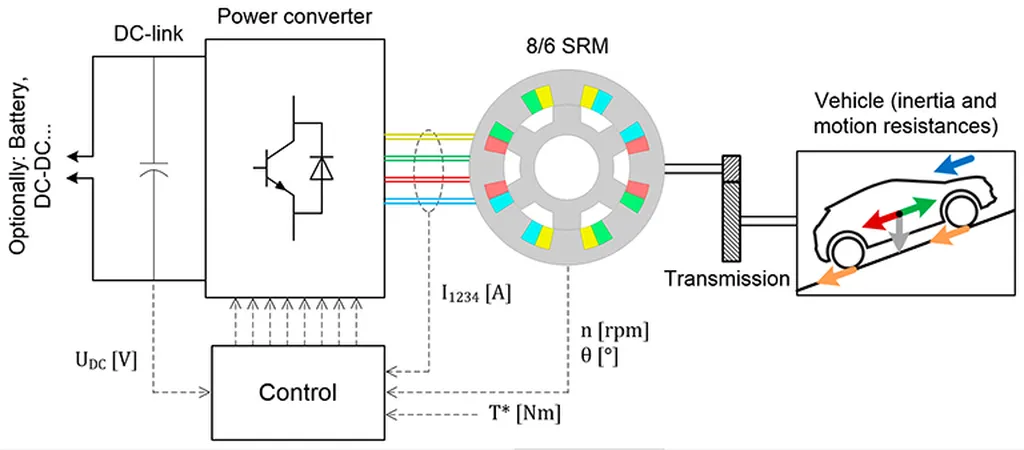
In the realm of electric drive systems, Switched Reluctance Motors (SRMs) have long been lauded for their simplicity and robustness, but their nonlinear characteristics and torque ripple have posed significant challenges. Enter Saritha Kandukuri, a researcher from the School of Engineering at Godavari Institute of Engineering and Technology (A) in Rajahmundry, India, who has developed a groundbreaking control strategy that promises to revolutionize the performance of SRMs.
Kandukuri’s study, published in the journal “Problems of the Regional Energetics” (which translates to “Problems of Regional Power Engineering”), focuses on improving speed regulation and reducing torque ripple in SRMs. The research introduces a hybrid control scheme that integrates a Cascaded Recurrent Neural Network (CRNN) controller with a Hysteresis Current-Controlled (HCC) Pulse Width Modulation (PWM) generator. This innovative approach is supported by a custom-designed (n+1) semiconductor and (n+1) diode power converter topology, operating on a 300V DC supply.
The results are impressive. The proposed CRNN-based control system achieves accurate phase current tracking within the hysteresis band and demonstrates quick dynamic performance, reaching a reference speed of 2000 rpm in just 0.06 seconds with a rise time of 0.03 seconds. Under various load conditions, the steady-state speed error is negligible. Moreover, the developed control method significantly reduces torque ripple after just one second of operation, maintaining a smoother torque profile across a wide speed range of 200-2000 rpm.
“This hybrid control scheme not only enhances the efficiency and reliability of SRMs but also makes them highly suitable for high-performance applications such as Electric Vehicle (EV) drives and industrial automation systems,” Kandukuri explains. The significance of these findings lies in their potential to address long-standing issues with SRMs, making them more competitive with other types of electric motors.
The implications for the energy sector are substantial. As the demand for electric vehicles and advanced industrial automation systems continues to grow, the need for efficient and reliable electric drive systems becomes ever more critical. Kandukuri’s research offers a promising solution, paving the way for the wider adoption of SRMs in these high-performance applications.
The study’s findings suggest that the proposed neural-network-based control architecture could be a game-changer in the field of electric drive systems. By improving the overall efficiency, reliability, and performance of SRMs, this research has the potential to shape future developments in the energy sector, driving innovation and advancing the capabilities of electric motors.
As the world continues to transition towards sustainable energy solutions, the work of researchers like Saritha Kandukuri will be instrumental in overcoming the technical challenges that lie ahead. Her groundbreaking research not only highlights the potential of SRMs but also underscores the importance of intelligent control strategies in enhancing the performance of electric drive systems.