
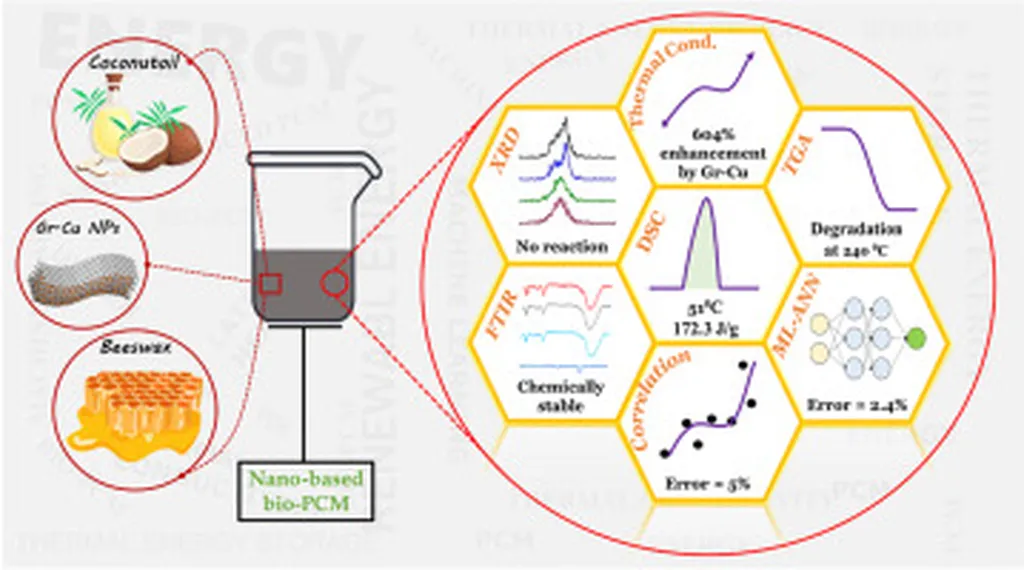
In a groundbreaking development poised to reshape energy systems, researchers have unveiled a novel bio-coating technology that significantly enhances condensation efficiency. The innovation, led by Behzad Rezaee from the Center of Excellence in Energy Conversion (CEEC) at Sharif University of Technology in Tehran, Iran, introduces a cost-effective and scalable solution using natural beeswax to infuse anodized aluminum nanocavities. This breakthrough, detailed in the journal ‘Applied Surface Science Advances’ (translated as ‘Advances in Applied Surface Science’), promises to revolutionize industries reliant on heat transfer and thermal management.
The technology, dubbed a solid-infused surface (SIS), actively modulates surface behavior by adjusting contact angles and reducing contact angle hysteresis to less than 5° under operating conditions. This dynamic adjustment facilitates efficient droplet formation and motion, even under high vapor flow. “The beeswax coating doesn’t just sit there; it actively responds to changes in temperature and vapor flow, making it far more effective than passive coatings,” Rezaee explained.
The implications for the energy sector are substantial. The beeswax-coated surfaces demonstrated a 44% improvement in the heat transfer coefficient (HTC) compared to bare aluminum at a 16°C subcooling temperature. Additionally, they achieved a peak heat flux of 330 kW/m² at 24°C. This performance outstrips conventional hydrophobic surfaces, particularly under high subcooling conditions where flooding typically reduces efficiency.
One of the most compelling aspects of this research is the emphasis on the dynamic role of the beeswax coating. Unlike most studies that focus on phase change materials (PCMs), Rezaee and his team highlight the state transition of beeswax—from solid to mushy to liquid—and its impact on droplet dynamics and thermal behavior. “This transition is crucial because it allows the coating to adapt to different conditions, ensuring optimal performance across a range of operating environments,” Rezaee noted.
Durability is another key advantage. The beeswax-coated samples maintained enhanced performance for 10 days when immersed in a wet environment and for 100 hours under continuous condensation tests. This robustness makes the technology particularly attractive for industrial applications where reliability and longevity are paramount.
The potential commercial impacts are vast. Enhanced condensation efficiency can lead to more effective desalination plants, improved thermal management in power generation, and more efficient renewable energy systems. “This technology has the potential to make a real difference in the energy sector, offering a sustainable and cost-effective solution for improving heat transfer processes,” Rezaee said.
As the world seeks innovative solutions to enhance energy efficiency and sustainability, this research opens new avenues for future developments. By leveraging the unique properties of beeswax, Rezaee and his team have not only advanced our understanding of condensation dynamics but also paved the way for more efficient and environmentally friendly energy systems. The journey towards a more sustainable future just got a significant boost, thanks to the humble bee and the ingenuity of modern science.