
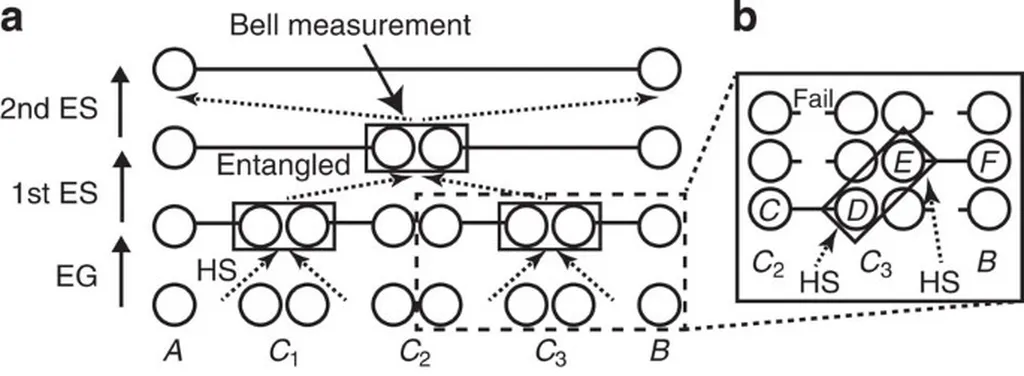
In a significant stride towards the future of quantum communication, researchers have proposed a novel architecture that bridges the gap between all-photonic and memory-based quantum repeaters. This development, published in the IEEE Transactions on Quantum Engineering (translated as the IEEE Journal of Quantum Engineering), could potentially revolutionize the way quantum networks are constructed and operated, with profound implications for the energy sector and beyond.
Quantum repeaters are crucial for extending the range of quantum communication networks, which are currently limited by signal loss and decoherence. Traditional memory-based quantum repeaters rely on quantum memories with long coherence times, a technology that remains challenging to implement. Enter Naphan Benchasattabuse, a researcher from the Graduate School of Media and Governance at Keio University in Fujisawa, Japan, who, along with his team, has proposed an innovative solution that leverages all-photonic quantum repeaters based on repeater graph states (RGSs).
“Our architecture enables seamless interoperability between all-photonic and memory-based quantum repeaters,” Benchasattabuse explained. “This significantly reduces the number of quantum memories required at end nodes, making the technology more practical and scalable.”
The proposed architecture abstracts all-photonic sections of the network as link-level connections between memory-equipped nodes, allowing for integration into existing network-level protocols. This approach not only simplifies the calculation of state fidelity but also outlines a communication protocol based on graph state manipulation rules for computing Pauli frame corrections, essential for obtaining the correct Bell pair.
The implications of this research are far-reaching, particularly for the energy sector. Quantum networks promise ultra-secure communication, which is paramount for protecting sensitive data related to energy infrastructure, grid management, and smart metering. Moreover, the ability to transmit quantum states over long distances could enable advancements in quantum sensing and metrology, enhancing the precision and efficiency of energy systems.
“By reducing the reliance on complex quantum memories, we are paving the way for more robust and scalable quantum networks,” Benchasattabuse added. “This could accelerate the deployment of quantum technologies in various industries, including energy, finance, and healthcare.”
The research also highlights the importance of interoperability in quantum networks. As the field evolves, the ability to integrate different types of quantum repeaters will be crucial for building a global quantum internet. The proposed architecture takes a significant step in this direction, offering a flexible and scalable solution that can adapt to the evolving needs of the quantum communication landscape.
In conclusion, the work of Benchasattabuse and his team represents a significant advancement in the field of quantum communication. By bridging the gap between all-photonic and memory-based quantum repeaters, they have opened new avenues for the development of robust, scalable, and interoperable quantum networks. As the energy sector continues to embrace digital transformation, the insights from this research could play a pivotal role in shaping the future of secure and efficient energy systems.