
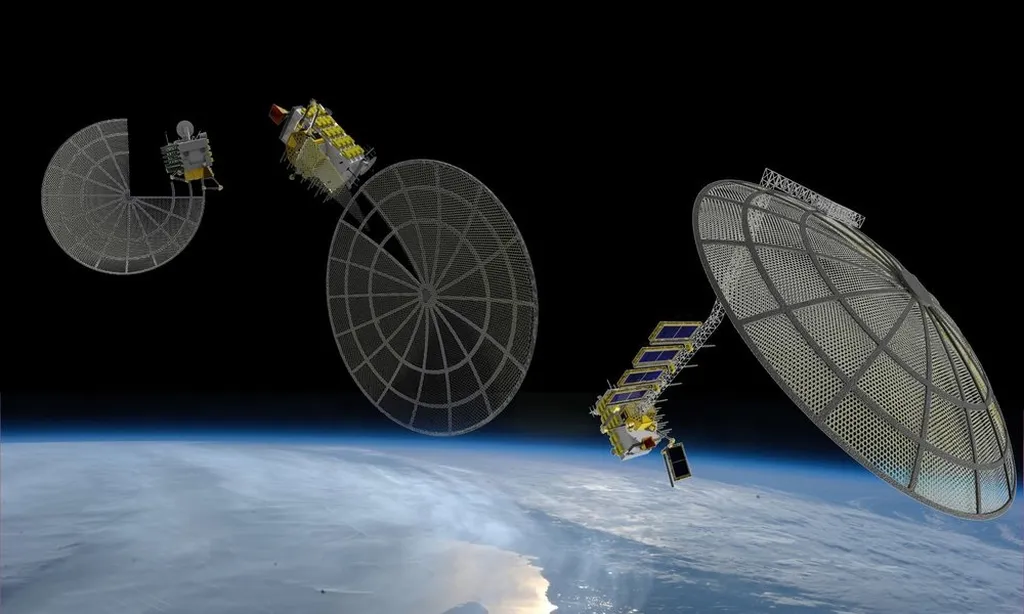
In the vast expanse of space, where traditional construction methods face formidable challenges, a new frontier of additive manufacturing is emerging, promising to revolutionize how we build in planetary environments. Researchers, led by Szabolcs Krizsma, have published a groundbreaking study in the journal *eXPRESS Polymer Letters* (which translates to *Express Polymer Letters* in English), exploring the potential of photopolymer-based additive manufacturing. This technology could significantly impact the energy sector and other industries, offering innovative solutions for off-world construction.
Photopolymer-based additive manufacturing involves using light to cure liquid resins into solid structures, a process known as photopolymerization. This method is particularly appealing for planetary environments due to its efficiency and versatility. “The ability to create complex structures on-demand, using locally sourced materials, could be a game-changer for establishing sustainable habitats on the Moon or Mars,” Krizsma explained.
One of the key advantages of this technology is its potential to produce thermoset materials, which are known for their excellent thermal stability and mechanical properties. Thermosets, once cured, maintain their shape and strength under extreme conditions, making them ideal for construction in harsh environments. “Thermosets are highly resistant to heat and chemicals, which is crucial for applications in the energy sector, such as in the production of durable, high-performance components for renewable energy systems,” Krizsma added.
The study also highlights the importance of crosslinking in the photopolymerization process. Crosslinking enhances the material’s strength and durability by forming a network of bonds between polymer chains. This property is particularly valuable for creating robust structures that can withstand the rigors of space exploration and the energy sector’s demanding applications.
The research opens up new avenues for innovation in the energy sector, where the need for durable, high-performance materials is paramount. For instance, photopolymer-based additive manufacturing could be used to create lightweight, yet strong components for wind turbines, solar panels, and other renewable energy systems. These components could be manufactured on-site, reducing transportation costs and environmental impact.
Moreover, the technology could enable the production of custom-designed parts tailored to specific environmental conditions, enhancing the efficiency and reliability of energy systems. “This technology has the potential to transform the way we approach construction and manufacturing in extreme environments, not just in space but also in remote or challenging terrestrial locations,” Krizsma noted.
While the study presents exciting opportunities, it also raises several open questions that need to be addressed. For instance, the long-term stability of photopolymer-based materials in planetary environments and their compatibility with existing construction techniques are areas that require further investigation. Additionally, the scalability of the technology and its economic viability need to be thoroughly explored.
Despite these challenges, the research published in *eXPRESS Polymer Letters* offers a compelling vision of the future, where photopolymer-based additive manufacturing plays a pivotal role in shaping the energy sector and beyond. As we continue to push the boundaries of what is possible, this technology could pave the way for sustainable and innovative solutions in construction and manufacturing, both on Earth and in the cosmos.