
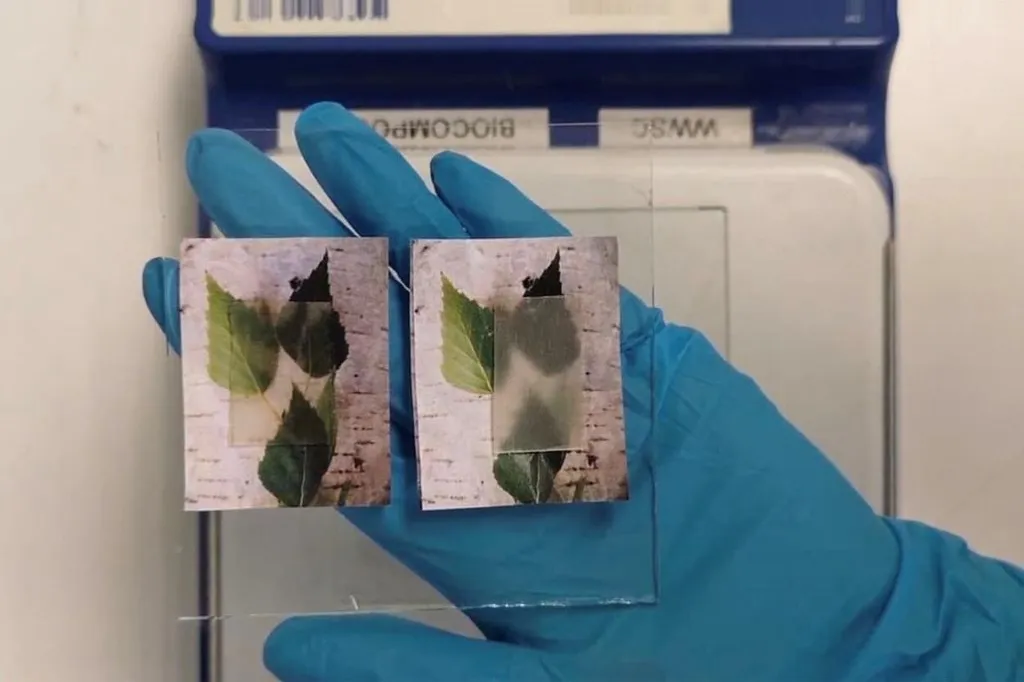
In a groundbreaking study published in the journal *Macromolecular Materials and Engineering* (translated from German as *Macromolecular Materials and Engineering*), researchers have uncovered the secrets behind enhancing the transparency of wood through alkali treatment, a discovery that could revolutionize the energy sector’s approach to sustainable materials. The research, led by Hitomi Yagyu from SANKEN (The Institute of Scientific and Industrial Research) at the University of Osaka Ibaraki in Japan, delves into the intricate world of wood’s cellular structure, offering insights that could pave the way for innovative applications in energy-efficient buildings and transparent wood composites.
The study focuses on the anisotropic transparency of alkali-treated wood, a phenomenon that has long puzzled scientists. By delignifying wood and then treating it with potassium hydroxide (KOH), the researchers found that the cellulose microfibril skeleton plays a crucial role in enhancing transparency. “The key lies in the densification of the cellulose microfibril skeleton during drying,” explains Yagyu. “This process reduces light scattering, making the wood highly transparent without the need for polymer impregnation.”
One of the most significant findings of the study is the differential swelling between the tangential and radial sections of the wood. The tangential sections, with their lower swelling ratio, undergo a more complete collapse of cell lumens, leading to higher density and superior transparency. This optical anisotropy, a direct consequence of the cellulose microfibril arrangement, was also evident in transparent wood-polymer composites.
The implications of this research for the energy sector are profound. Transparent wood, with its enhanced optical properties, could be used in energy-efficient windows and building materials, reducing the need for artificial lighting and lowering energy consumption. “This discovery opens up new possibilities for sustainable and energy-efficient construction materials,” says Yagyu. “The potential applications are vast, and we are excited to explore them further.”
The study not only sheds light on the underlying mechanisms of wood transparency but also highlights the importance of understanding the fundamental structure of materials. As we strive for a more sustainable future, such insights will be crucial in developing innovative solutions that harness the power of nature.
In the quest for sustainable and energy-efficient materials, this research marks a significant step forward. By unlocking the secrets of wood’s cellular structure, Yagyu and her team have opened the door to a new era of transparent wood composites, with far-reaching implications for the energy sector and beyond. As we continue to explore the potential of these materials, one thing is clear: the future of construction is looking increasingly green and transparent.