
In the heart of Italy, at the Politecnico di Torino, a team of researchers led by Dr. Emilia Prandini has been delving into the intricate world of crystal surfaces, aiming to unlock secrets that could revolutionize industries ranging from pharmaceuticals to energy. Their recent study, published in the journal *Advances in Applied Surface Science* (translated from *Applied Surface Science Advances*), sheds light on how the surface properties of crystalline materials can be tailored to enhance product performance, safety, and manufacturing efficiency.
Crystals, with their ordered atomic structures, have long been a subject of fascination and study. However, the unique properties of their different facets—flat surfaces that appear on the exterior of a crystal—remain a complex puzzle. Dr. Prandini and her team have taken a significant step towards solving this puzzle by combining computational modeling with advanced experimental techniques to understand and predict the surface properties of crystalline materials.
The team focused on quercetin-dimethylformamide (QDMF), a solvated form of quercetin, as their model compound. By using Particle Informatics tools, they analyzed the surface chemistry and topology of specific QDMF crystal facets. “We wanted to understand how the crystal structure and morphology influence properties like roughness, mechanical strength, and chemical features,” Dr. Prandini explained. “This understanding is crucial for designing materials with tailored surface properties.”
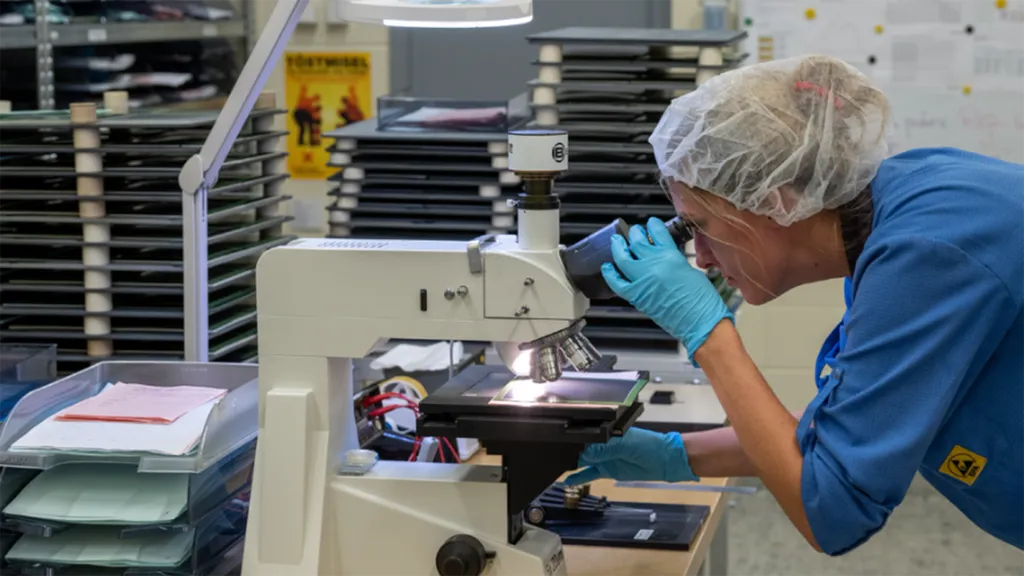
To validate their computational results, the researchers employed a suite of experimental techniques. Atomic Force Microscopy (AFM) integrated with Infrared (IR) spectroscopy provided topographical insights, chemical characterization, surface roughness measurements, and mechanical properties characterization. For high-resolution chemical imaging, they used advanced mid-infrared techniques such as Optical Photothermal Infrared (OPTIR) microscopy and scattering-type Scanning Near-field Infrared Microscopy (s-SNIM).
The results were promising. The experimental data aligned well with the simulations, demonstrating the potential of Particle Informatics tools in designing crystalline materials with specific surface properties. “This work is a significant step forward in the field of crystal engineering,” said Dr. Prandini. “It opens up new possibilities for designing materials with enhanced properties for various applications.”
The implications of this research are far-reaching, particularly for the energy sector. Crystalline materials are used in various energy applications, from solar cells to battery materials. Understanding and controlling their surface properties can lead to more efficient and durable energy storage and conversion devices. For instance, tailoring the surface properties of crystalline materials used in solar cells could enhance their light absorption capabilities, leading to more efficient solar energy conversion.
Moreover, the ability to predict and control the surface properties of crystalline materials can also improve manufacturing processes. By designing materials with specific surface properties, manufacturers can enhance product performance, reduce waste, and improve safety. This could lead to significant cost savings and environmental benefits.
Dr. Prandini’s work is not just about understanding the present but also about shaping the future. By providing a standardized procedure to correlate crystal structure packing and specific surface features, her research paves the way for the development of new materials with tailored properties. This could lead to breakthroughs in various fields, from energy to healthcare, and beyond.
As we stand on the brink of a new era in materials science, Dr. Prandini’s work serves as a beacon, guiding us towards a future where we can design and control materials at the atomic level. Her research is a testament to the power of interdisciplinary approaches, combining computational modeling with advanced experimental techniques to unlock the secrets of the crystalline world.