
In the ever-evolving landscape of wireless communication, a groundbreaking development has emerged from the Department of Electronics and Communication Engineering at Kalaignarkarunanidhi Institute of Technology. Lead author V. Govindaraj and his team have proposed a novel graphene-based log-periodic antenna designed to operate within the 0.1–1.3 GHz frequency range, potentially revolutionizing ultra-wideband (UWB) systems and complementing 5G networks.
The research, published in Discover Nano (translated as ‘Exploring Nano’), addresses critical challenges in UWB technology, including antenna size reduction, radiation stability, impedance matching, and cost-effectiveness. The proposed antenna leverages the unique properties of graphene, a material known for its exceptional conductivity and flexibility. By varying the DC voltage applied to the graphene, the antenna’s bandwidth, radiation pattern, and operating frequency range can be dynamically adjusted. This reconfigurability is achieved by altering the graphene’s chemical potential, surface conductivity, and surface impedance.
“Our design offers a compact, adaptable solution that can be fine-tuned to meet specific application requirements,” said Govindaraj. “This flexibility is crucial for the energy sector, where diverse communication needs must be met efficiently and cost-effectively.”
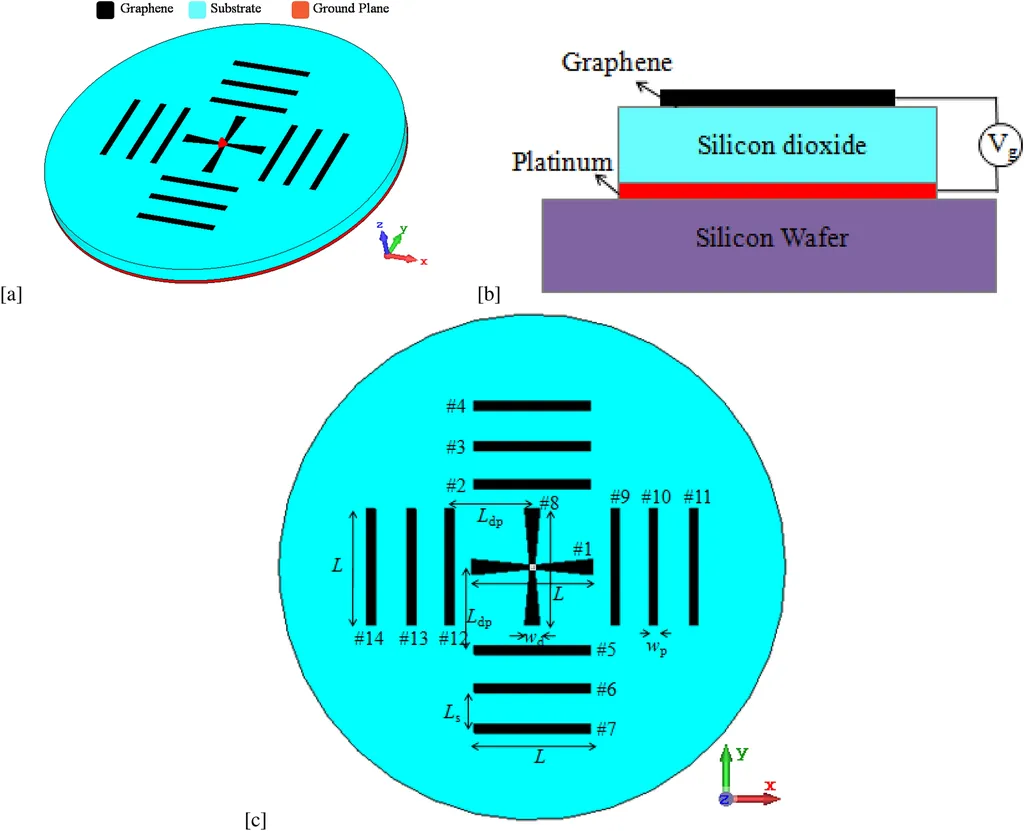
The antenna’s radiating element consists of a log-periodic graphene lattice coupled to a 50-ohm feed line. Simulation and implementation results demonstrate stable, directional radiation patterns over the wide frequency range of 0.1 to 1.3 GHz when the chemical potential of graphene is set to 1 eV. This innovation opens up new possibilities for applications in control, broadcast, and backward-compatibility services, particularly in sub-GHz wideband applications that complement 5G networks.
The implications for the energy sector are significant. As the demand for smart grids and advanced metering infrastructure grows, the need for reliable, high-performance communication systems becomes paramount. The proposed graphene-based antenna could play a pivotal role in enhancing the efficiency and reliability of these systems, ultimately leading to more robust and resilient energy networks.
Moreover, the research highlights the potential for further advancements in resonator structures, reconfigurability, and meta-surface designs. These developments could pave the way for even more sophisticated and high-gain antennas, ensuring that log-periodic architectures remain at the forefront of wireless communication technology.
As the energy sector continues to evolve, the integration of cutting-edge technologies like graphene-based antennas will be crucial in meeting the demands of a rapidly changing landscape. The work of Govindaraj and his team represents a significant step forward in this direction, offering a glimpse into the future of wireless communication and its transformative potential for the energy sector.