
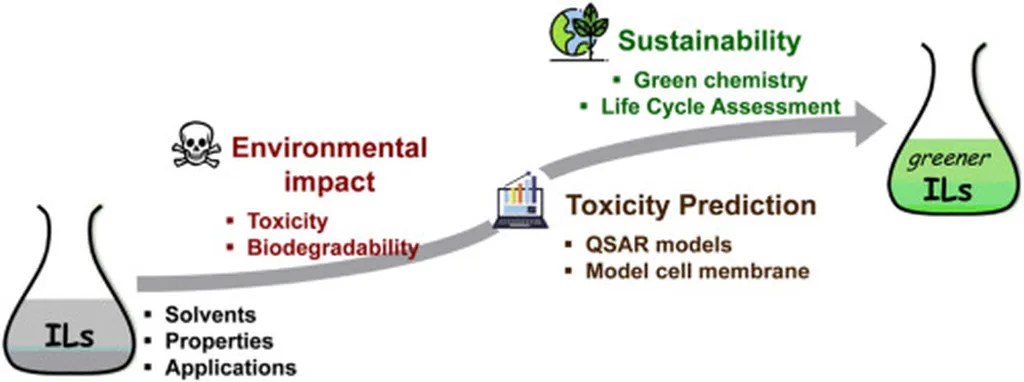
In the quest for greener industrial processes, a new study is shedding light on the potential and pitfalls of a promising class of chemicals known as ionic liquids. These “designer solvents,” as they’re often called, are gaining traction in various industries, including energy, due to their unique properties and versatility. But how do they fare in terms of environmental impact and toxicity? That’s the question Ayo Olasupo, a researcher at the Wonderful Institute for Sustainable Engineering and the University of Kansas, set out to answer in a recent study published in the journal *Cleaner Materials* (which translates to *Cleaner Materials* in English).
Ionic liquids are organic salts with low melting points, composed of tunable cations and anions. Their customizable nature has earned them a place in numerous industrial applications, from separations and nanotechnology to electrochemistry and catalysis. “They’re like Lego blocks for chemists,” Olasupo explains. “You can mix and match different components to design a solvent tailored to your specific needs.”
However, despite their widespread use, the environmental impact and toxicity of ionic liquids have remained largely understudied. Olasupo’s research aims to fill that gap by examining the fate of these chemicals in the ecosystem and their potential effects on plants, animals, and humans. The study also includes a life cycle assessment of ionic liquid processes, identifying limitations such as cost, synthesis, energy, and environmental impacts, particularly for the early generations of these solvents.
One of the most compelling aspects of Olasupo’s work is its potential to shape the future of industrial processes in the energy sector. By understanding the environmental implications of ionic liquids, researchers can develop strategies for synthesizing the next generation of these chemicals—ones that are low in toxicity, highly biodegradable, cost-effective, and environmentally friendly.
“This research is a crucial step towards sustainable industrial practices,” Olasupo says. “It’s not just about finding alternatives to traditional solvents; it’s about ensuring that these alternatives are safe and sustainable in the long run.”
The study’s findings could have significant commercial impacts, particularly in the energy sector, where ionic liquids are being explored for applications such as battery technology, fuel cells, and carbon capture. By providing a comprehensive overview of the environmental and health implications of these chemicals, Olasupo’s research could guide the development of safer, more sustainable industrial processes.
As the world continues to grapple with the challenges of climate change and environmental degradation, studies like Olasupo’s are more important than ever. They remind us that the pursuit of green technology is not just about innovation; it’s about responsibility. And in the case of ionic liquids, it’s about ensuring that these “designer solvents” live up to their name—not just in the lab, but in the real world.