
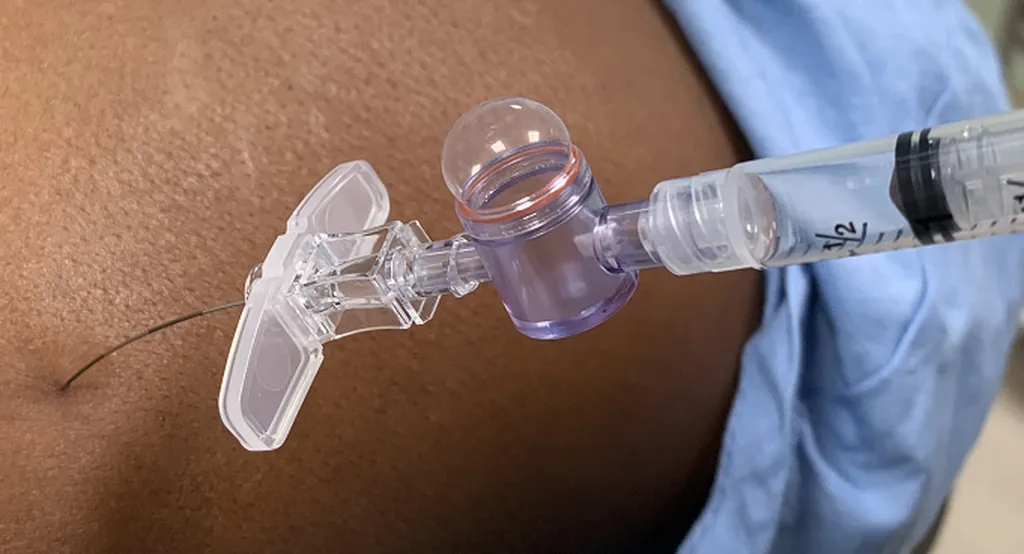
In the realm of medical technology, precision is paramount, and a recent breakthrough in epidural injection techniques is set to redefine standards in the field. Researchers, led by Gichan Cho from the Department of Robotics and Mechatronics Engineering at DGIST in Daegu, Republic of Korea, have developed an advanced optical force-sensing probe that significantly enhances the precision of puncture detection during epidural injections. This innovation, detailed in a study published in the *International Journal of Optomechatronics* (which translates to the *Journal of Light and Machine Integration*), promises to revolutionize pain intervention procedures, offering a more reliable and safer alternative to traditional methods.
Epidural injections are a critical component of pain management, but the current techniques, such as loss of resistance and fluoroscopy-guided procedures, come with notable drawbacks. These methods often rely on subjective assessments and expose patients to radiation. Cho’s team addressed these limitations by integrating a Fabry-Pérot interferometer-based force-sensing probe with a machine learning model. The probe’s offset between the needle tip and the force-sensing element is meticulously adjusted using a piezoelectric motor-based system, ensuring precise feedback control.
The study’s findings are compelling. Tests on silicone phantoms and ex-vivo specimens demonstrated that the system’s optimal offset range for enhancing puncture detection precision lies between 0.6 mm and 1 mm. This refinement led to a significant improvement in the Area Under the Curve (AUC) score for puncture detection, soaring from 0.61 to 0.86. “This approach secures the improvement of puncture detection reliability in robot-assisted epidural injection,” Cho explained, highlighting the potential impact of their work.
The implications of this research extend beyond the medical field, offering insights that could influence other sectors, including the energy industry. Precision in force-sensing technologies can enhance the accuracy of robotic systems used in various applications, from oil and gas exploration to renewable energy installations. As Cho noted, “The integration of machine learning with force-sensing technologies opens new avenues for automation and precision in multiple industries.”
The study’s publication in the *International Journal of Optomechatronics* underscores its significance in the scientific community. By combining cutting-edge optomechatronic technologies with advanced machine learning algorithms, Cho’s team has paved the way for more reliable and efficient medical procedures. This breakthrough not only promises to improve patient outcomes but also sets a new benchmark for precision in robotic-assisted interventions.
As the energy sector increasingly adopts robotic technologies for complex tasks, the lessons learned from this research could drive innovations in force-sensing and automation. The future of epidural injections, and perhaps other precision-driven fields, looks brighter with the integration of these advanced technologies. Cho’s work serves as a testament to the power of interdisciplinary research, bridging the gap between medical science and engineering to create solutions that benefit society at large.