
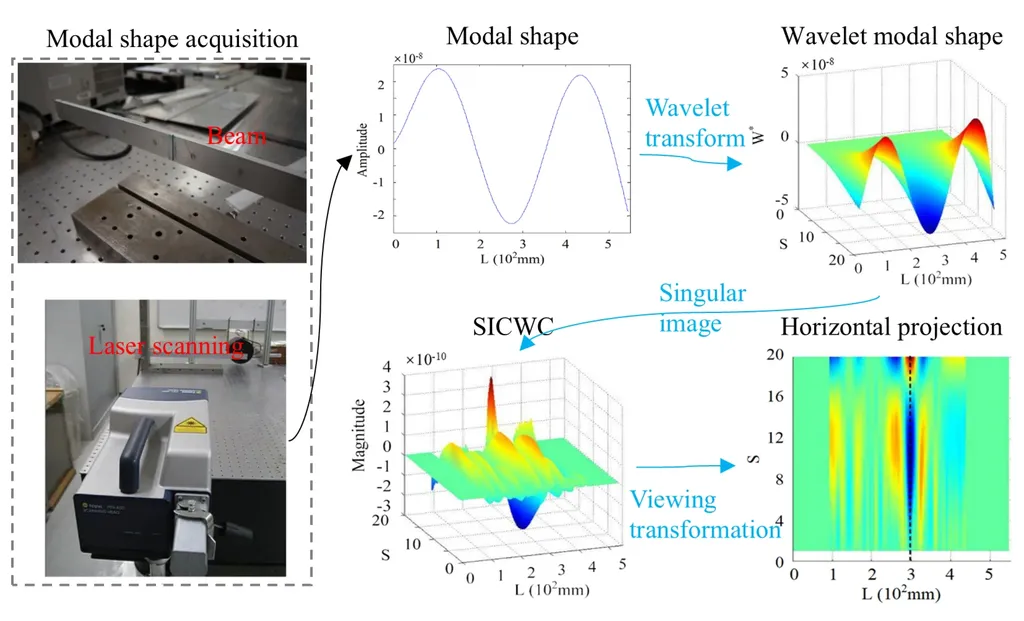
In a significant stride towards enhancing structural health monitoring, researchers have introduced a novel approach for damage detection in laminated composite beams, with promising implications for the energy sector. The study, led by Morteza Saadatmorad from the Department of Civil, Chemical, Environmental and Materials Engineering at the University of Bologna, Italy, explores the use of Legendre wavelet functions to identify damage in carbon-epoxy composite beams. This research, published in the open-access journal ‘Composites Part C: Open Access’ (translated as ‘Composites Part C: Open Access’), could revolutionize how we maintain and inspect critical infrastructure, particularly in the energy industry.
Composite materials are widely used in the energy sector due to their high strength-to-weight ratio and durability. However, detecting damage in these materials can be challenging. Traditional methods often fall short in providing accurate and timely damage assessments. This is where Legendre wavelets come into play. “Legendre wavelets offer a unique approach to damage detection by transforming the mode shapes of composite beams into a format that highlights damage-related features,” explains Saadatmorad.
The research involves generating Legendre wavelets by differentiating the first derivative of Legendre functions on a ten-digit grid using finite difference methods. This process results in three versions of the wavelets, each with varying numbers of sampling points. The study focuses on those with five and three sampling points, which are computed and applied to carbon-epoxy laminated composite beam mode shapes.
The effectiveness of these wavelets is validated through both numerical and experimental studies. The results are promising, demonstrating that all Legendre wavelet functions are suitable for damage detection in laminated composite beams. Notably, those derived from higher-degree Legendre polynomials show superior performance. “The higher-degree Legendre wavelets provide a more detailed and accurate representation of the damage, making them particularly effective for complex structures,” Saadatmorad adds.
The implications of this research are far-reaching, especially for the energy sector. Composite materials are extensively used in wind turbine blades, offshore structures, and pipelines. Ensuring the integrity of these structures is crucial for safety and operational efficiency. By employing Legendre wavelet functions, energy companies can achieve more accurate and timely damage detection, leading to proactive maintenance and reduced downtime.
Moreover, this innovative approach could pave the way for future developments in structural health monitoring. As Saadatmorad notes, “The versatility of Legendre wavelets makes them a valuable tool for a wide range of applications beyond composite beams. Their potential to enhance damage detection in various structural systems is immense.”
In conclusion, the introduction of Legendre wavelet functions represents a significant advancement in the field of damage detection. With their proven effectiveness in identifying damage in laminated composite beams, these wavelets offer a powerful solution for maintaining the integrity of critical infrastructure in the energy sector. As research continues to explore their applications, the potential for improving structural health monitoring across various industries becomes increasingly apparent.