
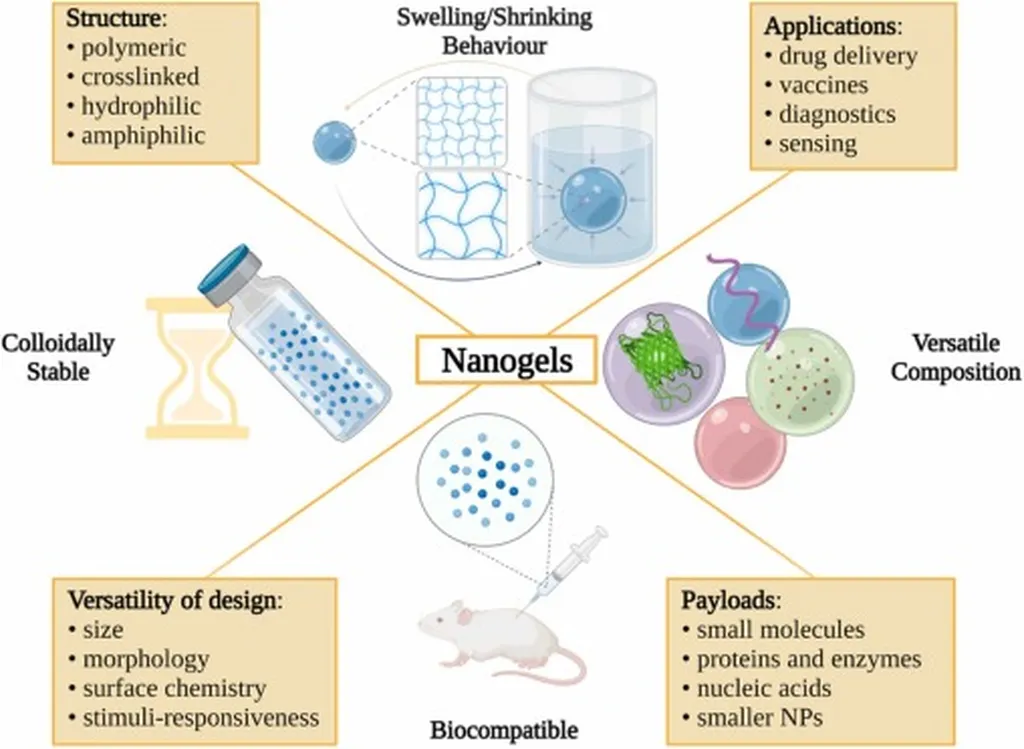
In the rapidly evolving world of advanced materials, a new bibliometric study has shed light on the global landscape and emerging trends of nanogels, offering valuable insights for researchers and industry professionals alike. Published in *Discover Nano* (which translates to “Exploring Nano” in English), the study, led by Yulai Liu from the Department of Information Center at The First Hospital of China Medical University, provides a comprehensive analysis of nanogel research from 2000 to 2024.
Nanogels, which are hydrogels embedded with nanoparticles, have garnered significant attention for their applications in drug delivery, biomedical engineering, and environmental remediation. The study, which analyzed 9,569 publications, revealed an overall growth trend in nanogel research, peaking in 2022 with 948 publications. China emerged as the most contributive country, with 3,785 publications, followed by the United States and India. The Chinese Academy of Sciences was identified as the most productive institution, with 335 publications, while Kazunari Akiyoshi was noted as the most prolific author, with 112 publications.
The study employed VOSviewer and Bibliometrix for co-authorship analysis and keyword co-occurrence analysis, respectively. This approach allowed the researchers to identify research hotspots and future trends in nanogel research. The analysis grouped 230 keywords into five clusters: nanogels and drug delivery; crosslinking chemistry of nanogels; nanogels in water treatment and biodegradation; nanogels and scaffolds; and temperature and pH-responsive nanogels.
One of the most compelling findings of the study is the identification of emerging research directions, particularly the application of novel nanogels in drug delivery and biomedical fields. “This study reveals the research trends, collaboration patterns, research hotspots, and emerging frontiers in nanogels research,” said Yulai Liu, the lead author of the study. “These findings can provide researchers with a comprehensive understanding of nanogels research and offer guidance for future research directions.”
The implications of this research are significant for the energy sector, particularly in the development of advanced materials for energy storage and conversion. Nanogels have shown promise in enhancing the performance of batteries and supercapacitors, as well as in the development of efficient and sustainable energy solutions. The study’s identification of research hotspots and emerging trends can guide researchers and industry professionals in their efforts to develop innovative materials for the energy sector.
Moreover, the study’s analysis of collaboration patterns can facilitate international collaboration and knowledge sharing, accelerating the pace of research and development in the field. As the demand for sustainable and efficient energy solutions continues to grow, the insights provided by this study can play a crucial role in shaping the future of the energy sector.
In conclusion, this bibliometric study provides a valuable resource for researchers and industry professionals interested in the development and application of nanogels. By offering a comprehensive analysis of the global landscape and emerging trends in nanogel research, the study can guide future research efforts and facilitate international collaboration, ultimately contributing to the development of advanced materials for the energy sector and beyond.