
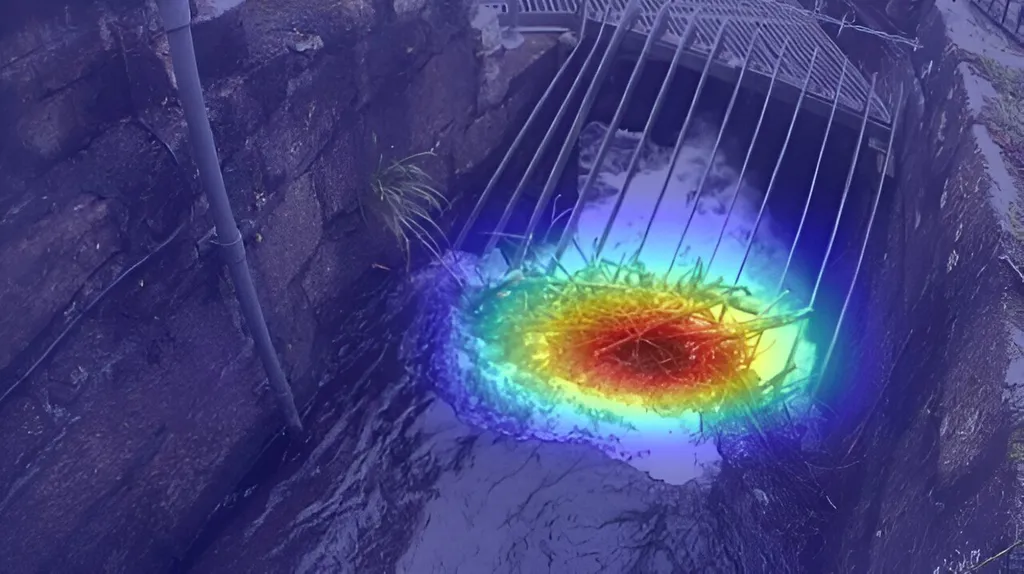
In the heart of bustling cities, where every second counts, a groundbreaking framework is set to revolutionize urban flood early warning systems. Woonggyu Choi, a researcher from the Department of Global Smart City at Sungkyunkwan University in South Korea, has developed a lightweight, operationally practical system that leverages existing CCTV infrastructure to provide real-time, anticipatory urban flood warnings. This innovation, published in the journal *Developments in the Built Environment* (translated as “Developments in the Built Environment”), could significantly impact the energy sector by enhancing system safety and reducing downtime during flood events.
The system, which focuses on detecting incipient flood-risk signals from surveillance video, translates these signals into interpretable short-term warning indicators. Unlike traditional methods that rely on long-horizon hydrological forecasting, Choi’s framework extracts visual water-occupancy signals from CCTV footage and applies Page–Hinkley-based change-point detection to identify statistically meaningful rising trends under noisy urban conditions.
“Our framework is designed to be robust and economically scalable, making it particularly suitable for environments where dense sensor networks or computationally intensive hydrological models are impractical,” Choi explains. The system’s ability to provide an average early-warning lead time of 32.9 seconds during the pre-flood stage is a game-changer for urban flood management.
The commercial implications for the energy sector are substantial. Urban floods can cause significant damage to infrastructure, leading to costly downtime and potential safety hazards. By providing real-time, accurate flood warnings, this system can help energy companies mitigate risks, protect assets, and ensure continuous service delivery. “This technology can be a lifesaver, not just for people but also for businesses that rely on uninterrupted operations,” Choi adds.
The framework’s success is underscored by its empirical validation across multiple urban flood scenarios, which confirmed zero false positives under normal conditions and secured an impressive early-warning lead time. With a flood segmentation model achieving an mAP of 85.1%, the system’s reliability and accuracy are evident.
As cities continue to grow and weather patterns become more unpredictable, the demand for efficient and effective flood management solutions will only increase. Choi’s research, published in *Developments in the Built Environment*, offers a promising path forward, demonstrating how existing infrastructure can be repurposed to enhance urban resilience. This innovation could shape future developments in the field, paving the way for smarter, safer cities.
In an era where technology and urbanization are rapidly advancing, Choi’s work serves as a reminder of the power of innovation in addressing critical challenges. As the energy sector continues to evolve, the integration of such advanced warning systems could become a standard practice, ensuring that cities and their inhabitants are better prepared for the uncertainties of a changing climate.