
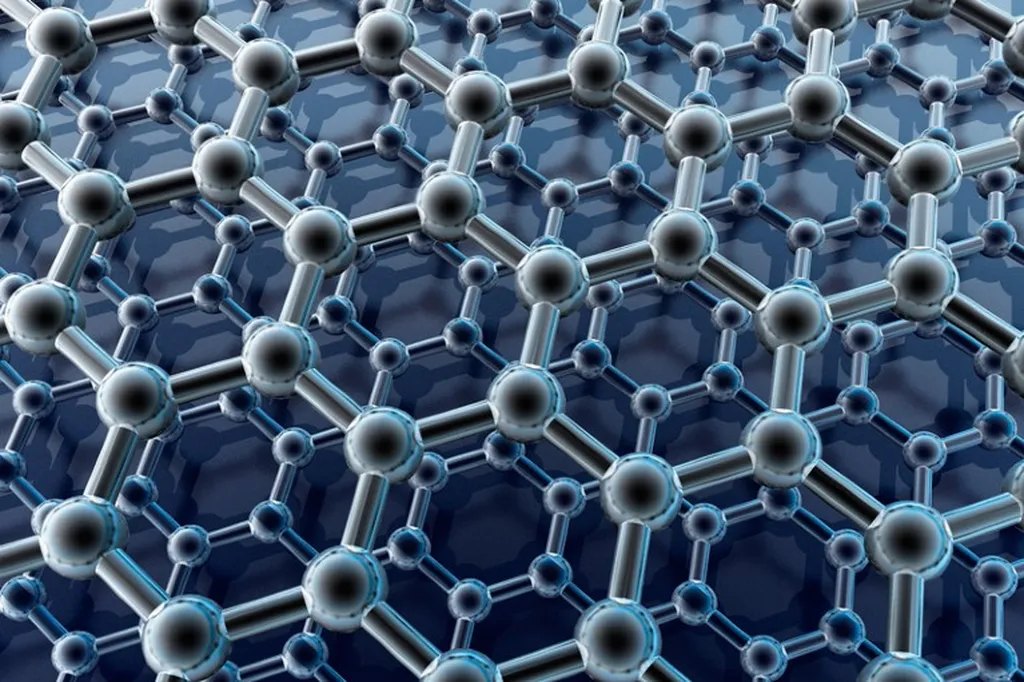
In the quest to harness the full potential of advanced materials, scientists have long grappled with the complexities of thermal transport in disordered, or amorphous, structures. A recent study published in the journal *Science, Technology and Advanced Materials: Methods* (formerly known as Science and Technology of Advanced Materials: Methods) offers a groundbreaking approach to this challenge, with implications that could resonate deeply within the energy sector.
At the heart of this research is Kosuke Yamazaki, a researcher at the Graduate School of Engineering Science, The University of Osaka, who has turned to a relatively new mathematical tool called persistent homology to unravel the mysteries of thermal conductivity in amorphous graphene. This technique, a branch of topological data analysis, allows scientists to extract essential structural features from complex, disordered materials.
“Persistent homology provides a unique way to identify and quantify the medium-range structural motifs that are crucial for understanding thermal transport,” Yamazaki explains. By using these topological descriptors in a machine-learning model, Yamazaki and his team achieved highly accurate predictions of thermal conductivity. But the real breakthrough came when they delved deeper to interpret the results.
Through an inverse analysis, the researchers mapped the regression coefficients back onto the persistence diagrams, revealing that distorted hexagonal and triangular motifs are strongly correlated with reduced thermal conductivity. This finding was further supported by examining the spatial distribution of localized vibrational modes, which are known to suppress thermal transport.
The implications of this research are profound, particularly for the energy sector. Amorphous materials are increasingly being considered for applications in thermoelectric devices, thermal barrier coatings, and other energy-related technologies. A deeper understanding of how structural motifs influence thermal transport could lead to the design of materials with tailored thermal properties, enhancing the efficiency of these devices.
“Our approach not only enables accurate physical property prediction but also uncovers meaningful structure-property relationships,” Yamazaki notes. This dual capability—predictive power coupled with interpretability—is a significant step forward in the field of materials science.
As the world continues to seek sustainable energy solutions, the ability to engineer materials with precise thermal properties will be crucial. Yamazaki’s work opens up new avenues for exploring and exploiting the potential of amorphous materials, paving the way for innovative advancements in energy technologies. By bridging the gap between complex mathematical tools and practical applications, this research offers a promising framework for the future of materials science.