
In the realm of structural engineering, reinforced concrete dapped-end beams have long posed a challenge due to their complex behavior under load. These regions of discontinuity, often found in beams, require sophisticated models for accurate analysis and design. A recent study published in the Brazilian Journal of Structural and Material Engineering (Revista IBRACON de Estruturas e Materiais) sheds new light on this topic, offering insights that could reshape design practices and enhance the safety and efficiency of structures in the energy sector and beyond.
Led by Rejane Martins Fernandes Canha, a researcher affiliated with a prominent Brazilian institution, the study employs nonlinear numerical simulations based on the finite element method to investigate the behavior of reinforced concrete corbels. The research is a significant step forward in understanding how these structural elements perform under various conditions.
The study’s findings are particularly relevant for the energy sector, where robust and efficient structural designs are crucial for supporting heavy machinery and ensuring the integrity of critical infrastructure. “Our research demonstrates that the shear capacity of dapped-ends increases with a reduction in the shear span-to-effective depth ratio,” explains Canha. This insight could lead to more optimized designs, reducing material usage and construction costs without compromising safety.
One of the most compelling aspects of the study is its validation of numerical results against experimental data. By comparing loads, deflections, reinforcement strains, cracking patterns, and failure modes, the researchers ensured the accuracy of their simulations. This rigorous approach lends credibility to their findings and paves the way for broader applications in real-world scenarios.
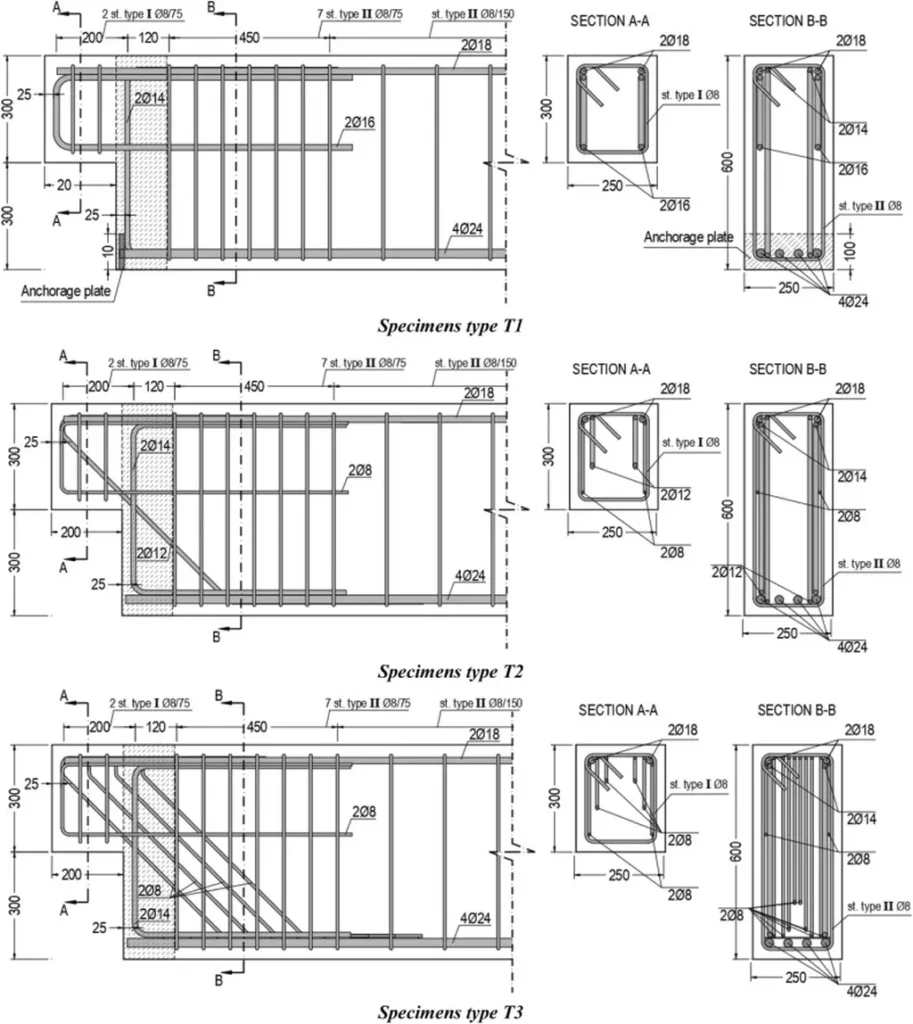
The study also highlights the superior performance of dapped-ends with inclined hanger bars. These configurations exhibited more moderate crack openings, suggesting better stress redistribution and higher load-bearing capacity compared to those with vertical bars. This discovery could influence future design guidelines, promoting the use of inclined bars in critical applications.
Following the validation, the researchers conducted numerical simulations on specimens designed using the strut-and-tie and shear-friction models according to Brazilian standards. Their analyses confirmed that the aspect ratio limits recommended by the Brazilian code are adequate for designing according to these models. This validation provides a solid foundation for engineers to rely on these models with confidence.
The implications of this research extend beyond the energy sector, impacting various industries that rely on reinforced concrete structures. By offering a deeper understanding of dapped-end behavior, the study enables engineers to make more informed design decisions, ultimately leading to safer and more cost-effective constructions.
As the construction industry continues to evolve, the insights gained from this research will be invaluable. The study not only advances our knowledge of reinforced concrete dapped-end beams but also sets a precedent for future investigations in structural engineering. With the findings published in the Brazilian Journal of Structural and Material Engineering, the research is poised to make a significant impact on both national and international stages.
In a field where precision and reliability are paramount, this study stands as a testament to the power of advanced numerical simulations and rigorous experimental validation. As Rejane Martins Fernandes Canha and her team continue to push the boundaries of structural engineering, their work will undoubtedly shape the future of construction and design.