
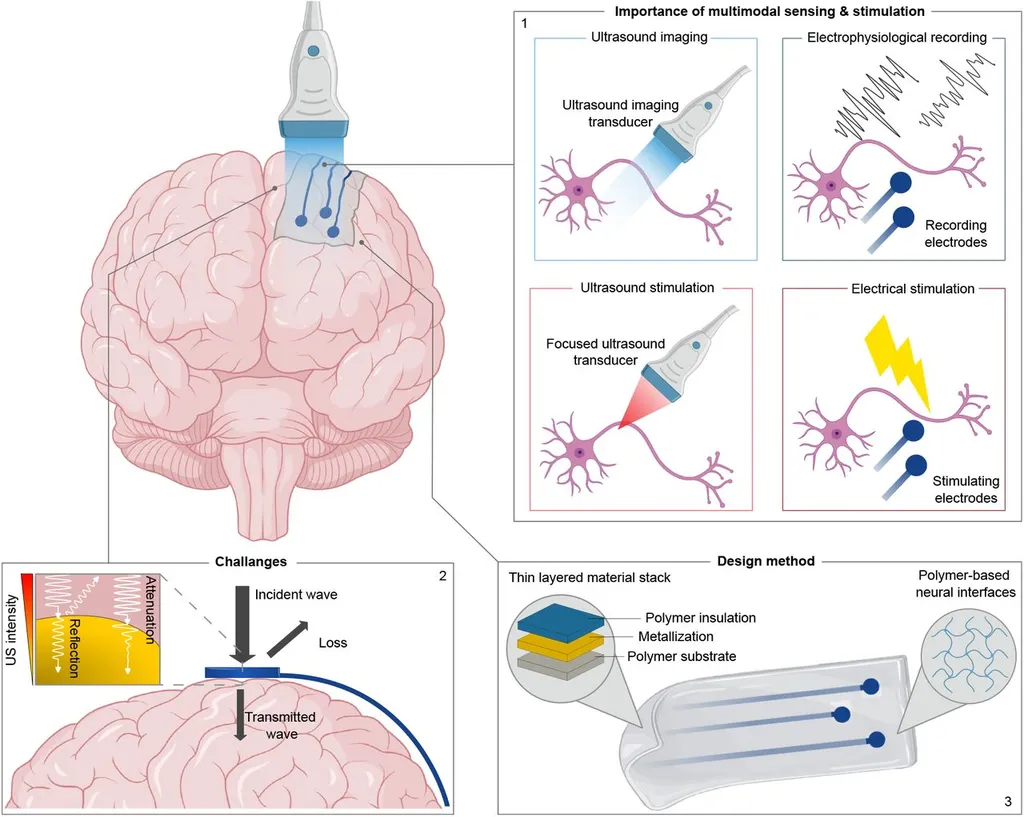
In a groundbreaking development poised to reshape the landscape of neural interfaces, researchers from Delft University of Technology have introduced a novel approach to creating ultrasound-transparent neural interfaces. This innovation, led by Raphael Panskus from the Department of Microelectronics, promises to bridge the gap between diagnostic and therapeutic functionalities in neuroscience and neurotechnology.
Traditional neural interfaces, often made from metal-based microelectrodes, have long been hindered by their inability to propagate ultrasound waves effectively. This limitation has restricted their compatibility with functional ultrasound imaging (fUSI), a powerful modality for high-resolution, non-invasive monitoring of brain function and structure. Panskus and his team have tackled this challenge head-on, presenting flexible, ultrasound-transparent neural interfaces that maintain practical metal thicknesses while achieving high acoustic transparency.
The research, published in the journal ‘npj Flexible Electronics’ (translated to English as ‘npj Flexible Electronics’), introduces a theoretical and simulation-based framework to explore the conditions under which commonly used polymers and metals in neural interfaces can become acoustically transparent. “By understanding the fundamental principles governing ultrasound propagation through these materials, we were able to propose design guidelines that maximize ultrasound transmission,” Panskus explained. This approach not only enhances the diagnostic capabilities of neural interfaces but also paves the way for their integration with therapeutic focused ultrasound (FUS).
The team validated their approach through a series of experiments, including immersion tests and fUSI in phantom and in vivo settings. The results demonstrated the acoustic transparency of their engineered interfaces, marking a significant step forward in the development of multimodal neural interfaces. “Our work establishes a foundation for neural interfaces with enhanced diagnostic and therapeutic capabilities, enabling both scientific discovery and translational impact,” Panskus added.
The implications of this research extend beyond the realm of neuroscience, offering potential benefits for the energy sector as well. The principles underlying ultrasound-transparent materials could inspire innovations in energy harvesting and storage technologies, particularly in the development of flexible and efficient energy devices. As the world continues to seek sustainable energy solutions, such advancements could play a crucial role in shaping the future of the energy landscape.
This study not only highlights the importance of interdisciplinary research but also underscores the potential of collaborative efforts to drive technological progress. By pushing the boundaries of what is possible, Panskus and his team have opened new avenues for exploration and innovation in the field of neural interfaces and beyond. As the scientific community continues to build upon these findings, the future of neurotechnology and energy solutions looks increasingly promising.