
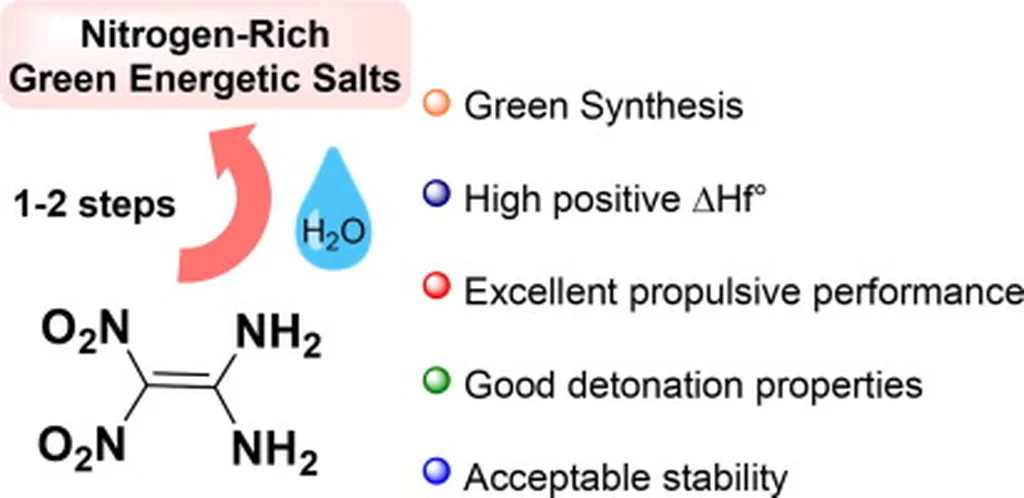
In a groundbreaking development poised to reshape the energy sector, researchers have successfully pushed the boundaries of binary carbon-nitrogen (CN) compounds, unlocking new potential for high-performance materials. The study, led by Xiaofeng Yuan of the School of Chemistry and Chemical Engineering at Nanjing University of Science and Technology, introduces a novel series of nitrogen-rich pentazolate salts that could revolutionize the way we think about energetic materials.
At the heart of this research lies the ingenious incorporation of azido groups into nonmetallic pentazolate salts. “By introducing azido groups, we’ve not only enhanced the interactions between cations and anions but also significantly boosted the detonation performance of these compounds,” Yuan explains. This enhancement is crucial for applications in the energy sector, where high-performance materials are in constant demand.
The study, published in *Energy Material Advances* (translated as “Advances in Energy Materials”), delves into the intricate details of these interactions. Using advanced analytical techniques like atomic dipole moment corrected Hirshfeld and symmetric-adapted perturbation theory, the researchers discovered that increasing the number of azido groups further polarizes the ionic systems, leading to stronger electrostatic attractions. This finding is a game-changer, as it provides a clear pathway to designing materials with enhanced stability and performance.
One of the standout achievements of this research is the synthesis of azidoformamidinium pentazolate, which outperforms most currently known nonmetallic pentazolate salts in terms of detonation performance. “Given its practical applicability and synthetic safety, the azidoformamidinium pentazolate was prioritized for synthesis,” Yuan notes. This compound not only tames the azido group and cyclo-N5− within a nitrogen-rich compound but also achieves an impressive CN ratio of 1:14 in the triazidocarbenium pentazolate.
The implications for the energy sector are profound. These novel compounds could lead to the development of more efficient and powerful explosives, propellants, and other energetic materials. The enhanced stability and performance of these materials could also open up new avenues for their use in various industrial applications, from mining to aerospace.
Moreover, the research provides valuable insights into the decomposition pathways of these compounds, thanks to differential scanning calorimetry, ab initio molecular dynamics, and transition state theory. This deeper understanding could pave the way for the development of safer and more controllable energetic materials.
As we look to the future, this research offers a novel approach to pushing the boundaries of binary CN compounds. By continuing to explore and innovate in this field, we can expect to see significant advancements in the performance and applicability of energetic materials, ultimately shaping the future of the energy sector.
In the words of Yuan, “This research aims to provide valuable insights for improving the performance of pentazolate derivatives and proposes a novel approach to pushing the boundaries of binary CN compounds.” With such promising developments on the horizon, the energy sector is poised for a transformative leap forward.