
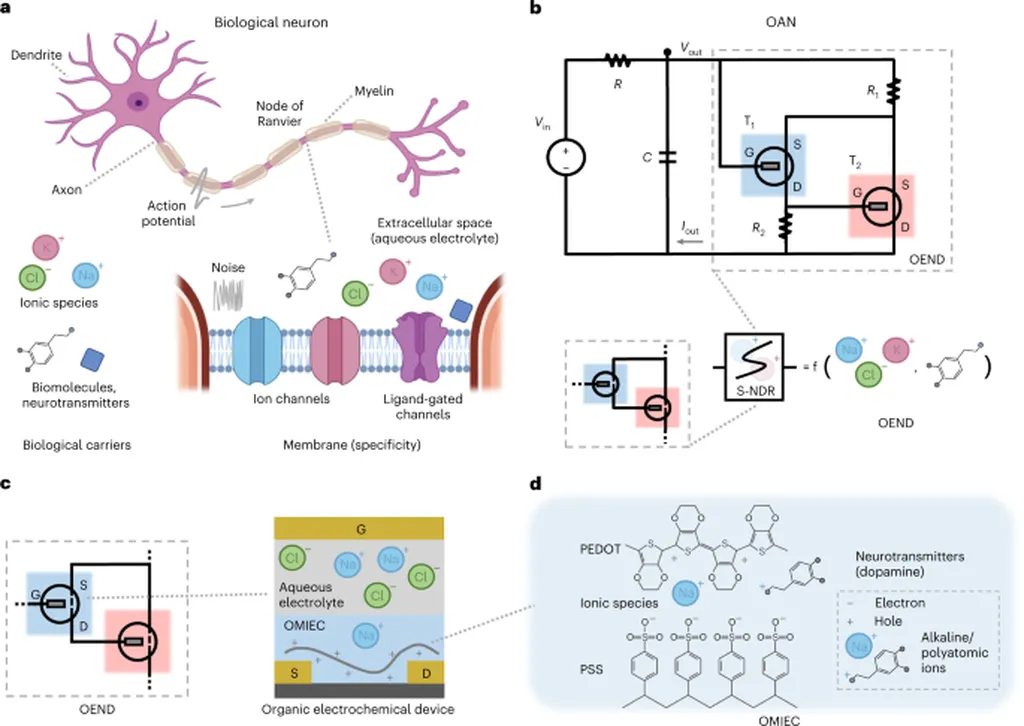
In a groundbreaking development that could revolutionize the way we think about flexible electronics and neuromorphic computing, researchers have unveiled the first organic spiking neuron capable of mimicking the complex behavior of biological neurons. This innovation, led by Mohammad Javad Mirshojaeian Hosseini from the School of Engineering Technology at Purdue University, opens up new possibilities for integrating soft, flexible electronics with biological systems and soft robots.
The research, published in the journal *npj Flexible Electronics* (which translates to “Flexible Electronics” in English), introduces an artificial neuron constructed entirely from organic materials. This neuron, built using complementary organic field-effect transistors and capacitors on a flexible substrate, can emulate key neural functions such as signal integration, frequency modulation, and coincidence detection. Perhaps most notably, it features both excitatory and inhibitory synapses, which are crucial for the complex computations performed by biological neural networks.
“The ability to create an organic neuron that can mimic the behavior of biological neurons is a significant step forward,” said Hosseini. “This technology has the potential to bridge the gap between rigid, silicon-based electronics and the soft, flexible structures found in nature and biological systems.”
One of the most compelling aspects of this research is its potential impact on the energy sector. Traditional neuromorphic systems, which aim to emulate the brain’s efficient computing capabilities, often rely on rigid, energy-intensive silicon technologies. The organic neuron developed by Hosseini and his team, however, offers a more flexible and potentially more energy-efficient alternative. This could lead to the development of soft, flexible sensors and actuators that can be integrated into energy-harvesting systems, smart grids, and other applications where traditional electronics fall short.
“The energy sector is always looking for ways to improve efficiency and reduce costs,” Hosseini explained. “Our organic neuron technology could pave the way for new types of energy-harvesting devices that are more adaptable and responsive to their environment.”
The research also demonstrates the neuron’s ability to interact with the environment through a light-control feedback loop that adjusts luminance based on ambient light intensity. This showcases the potential for organic neurons to be used in a wide range of applications, from smart lighting systems to advanced robotics.
As the field of neuromorphic computing continues to evolve, the development of organic neurons represents a significant milestone. By providing a flexible, energy-efficient alternative to traditional silicon-based technologies, this research could shape the future of soft robotics, biological integration, and energy systems. The implications are vast, and the potential for innovation is immense.
“This is just the beginning,” Hosseini said. “We are excited to explore the many possibilities that this technology offers and to see how it can be applied in various industries, including energy.”