
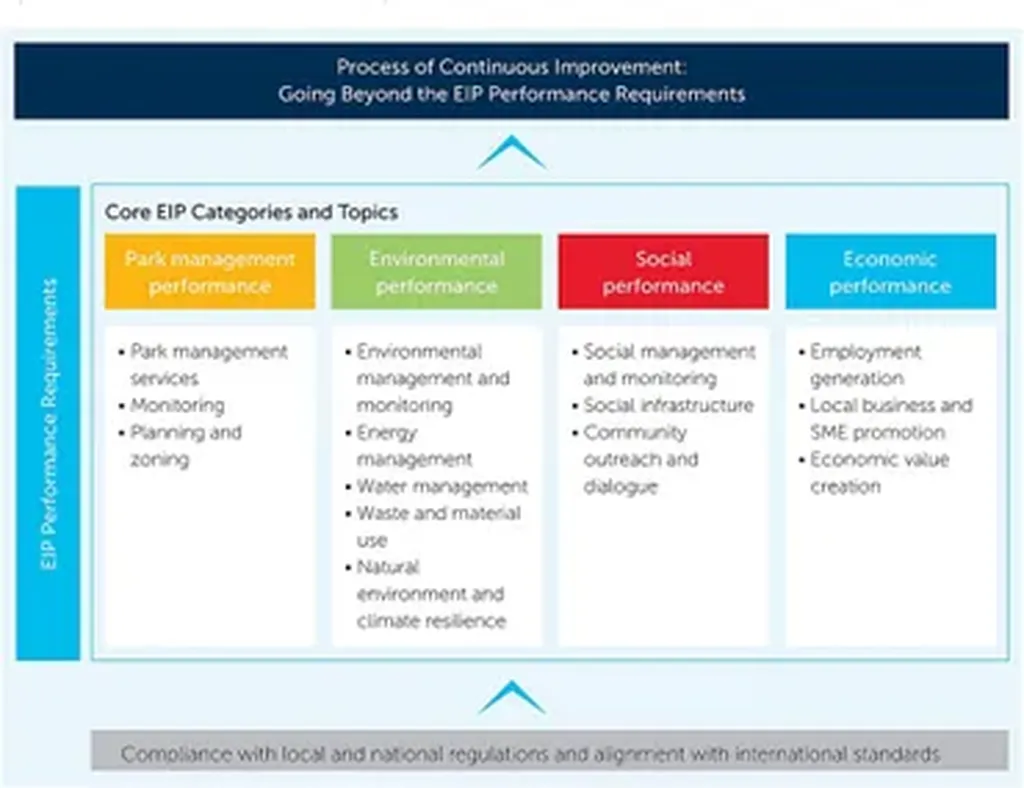
In a significant stride towards sustainable urban development, researchers have introduced a novel approach to evaluate and enhance the performance of eco-industrial parks (EIPs), with promising implications for the energy sector. The study, led by Debora Anelli from the Department of Architecture and Project at Sapienza University of Rome, proposes a two-phase decision-support framework that could revolutionize how EIPs are managed and improved.
EIPs are pivotal in the shift towards circular and low-carbon economies, yet their Environmental, Social, and Governance (ESG) performance has traditionally been assessed through static metrics. Anelli and her team have developed a dynamic model that not only measures gaps in performance but also identifies cost-effective improvement measures. “Our framework bridges the gap between assessment and decision-making, providing a transparent tool for policymakers and EIP managers,” Anelli explains.
The two-phase model begins with a passive assessment that measures the gaps between current performance and regulatory targets or best practices. In the active phase, the model identifies improvement measures that are both cost-effective and feasible within budgetary and technical constraints. This approach was applied to two European EIPs: Envipark in Italy and Kalundborg in Denmark.
The results revealed distinct strategic trajectories for each park. Envipark, for instance, showed criticalities primarily in the environmental dimension, leading to a focus on incremental and demonstrative measures. On the other hand, Kalundborg, which already performs well environmentally, is prioritizing transformative, large-scale initiatives to address its social indicators, particularly those related to welfare and community engagement.
The study, published in *Frontiers in Built Environment* (translated to English as “Frontiers in the Built Environment”), offers a replicable framework that could significantly impact the energy sector. By aligning investment decisions with ESG and decarbonization goals, this model could drive more sustainable and efficient energy production and consumption within EIPs.
Anelli’s work is not just about assessing performance; it’s about enabling action. “Our framework provides a clear path forward, helping EIPs to not only meet regulatory standards but also to strive for best practices,” she says. This could lead to more integrated and sustainable urban development strategies, ultimately benefiting the energy sector and the environment alike.
As the world continues to grapple with climate change and the need for sustainable development, this research offers a beacon of hope. By providing a clear, actionable path towards improved ESG performance, Anelli and her team are paving the way for a more sustainable future. The energy sector, in particular, stands to gain from this approach, as it could lead to more efficient and environmentally friendly energy production and consumption within EIPs. This is not just a step forward; it’s a leap towards a more sustainable and resilient future.