
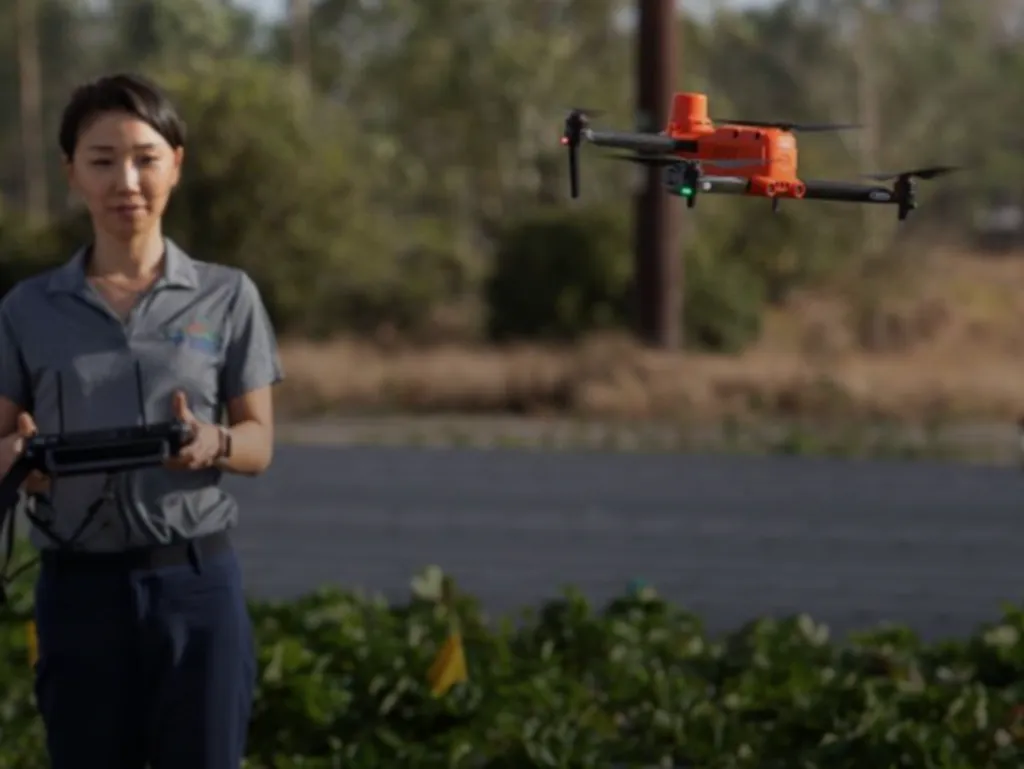
In the bustling, ever-evolving world of urban infrastructure, autonomous drones are becoming indispensable tools for inspection, monitoring, and navigation. Yet, their operations are fraught with complexities, balancing multiple objectives like collision avoidance, wind management, and signal coverage. Enter Bowen Sun, a researcher from the Informatics, Cobots and Intelligent Construction (ICIC) Lab at the University of Florida, who has developed a groundbreaking method to make these drones’ decision-making processes more transparent and efficient.
Sun’s research, published in the journal *Frontiers in Built Environment* (translated to English as *Frontiers in the Built Environment*), introduces a novel approach to Multi-Objective Reinforcement Learning (MORL) that augments autonomous drone operations with an interpretable priority interface. This innovation is a game-changer for the energy sector, where drones are increasingly used for inspecting power lines, monitoring solar farms, and assessing wind turbine conditions.
The key to Sun’s breakthrough is a lightweight group-gating architecture that categorizes raw observations into meaningful groups—such as goal information, kinematics, wind, position, signal coverage, penalties, and obstacle distance—and learns to reweight these groups at every decision step. “This architecture preserves task performance while revealing stable priority patterns,” Sun explains. “It’s like giving the drone a clear set of priorities, almost like a checklist, which makes its decisions more understandable and adaptable.”
The implications for the energy sector are profound. For instance, drones equipped with this technology can better navigate around wind turbines, avoiding collisions while efficiently collecting data. They can also prioritize signal coverage to ensure seamless communication, even in dynamic and partially observable environments. “The dual-mode behavior of the gate dynamics allows the drone to track global task difficulty and make category-specific reallocations,” Sun adds. “This means the drone can adapt to changing conditions, such as sudden wind gusts or unexpected obstacles, in real time.”
One of the most compelling findings from Sun’s research is the improved alignment of observation priorities with environmental dynamics. Using Dynamic Time Warping analysis, Sun found a 39% improved alignment for wind and a 19% improvement for obstacle distance when tracking changes rather than absolute levels. This means drones can better anticipate and respond to environmental changes, making them more reliable and efficient in critical operations.
The commercial impact of this research is significant. Energy companies can deploy drones with greater confidence, knowing that their operations are not only efficient but also transparent and adaptable. This could lead to cost savings, improved safety, and enhanced data collection, ultimately driving better decision-making and maintenance strategies.
Looking ahead, Sun’s research sets the stage for future developments in autonomous drone operations. The interpretable priority interface could pave the way for real-time monitoring, adaptive sensor scheduling, and early fault-detection heuristics. “This protocol provides a basis for exploring new ways to make drones more intelligent and reliable in urban operations,” Sun concludes.
As the energy sector continues to embrace autonomous drones, Sun’s work offers a glimpse into a future where these machines are not just tools but intelligent partners, working alongside human operators to navigate the complexities of urban infrastructure with ease and precision.