
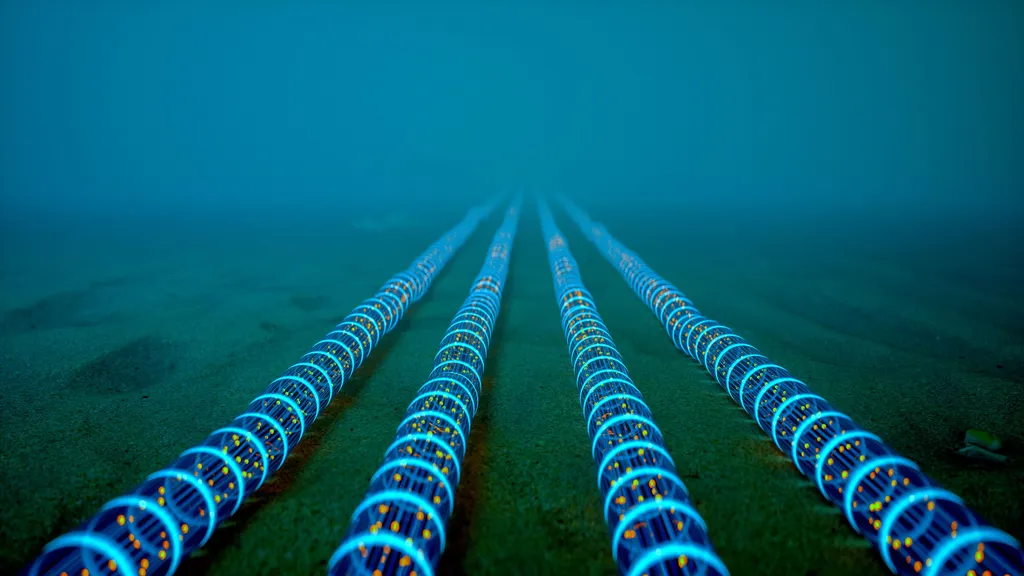
In the depths of the ocean, where submarine cables are the lifelines of our interconnected world, ensuring their safe transport and installation is paramount. A recent study led by Y. Wang from the School of Mechanical Engineering at Jiangsu Ocean University in China has shed new light on the dynamic responses of submarine cable pallets, offering valuable insights for the energy sector.
Submarine cables, crucial for offshore wind farms and other marine renewable energy projects, are typically transported and installed using specialized pallets. However, the dynamic interactions between the cables and these pallets during the dropping process have been poorly understood—until now. Wang’s research, published in the journal *Mechanical Sciences* (translated from Chinese as *机械科学*), has developed a dynamic model that accurately captures these interactions, providing a foundation for improved stability assessments and engineering applications.
The study first validated the necessity of incorporating the submarine cable into the model by analyzing the dynamic responses of the pallet under varying cable mass conditions. “We found that the displacement of the pallet’s web plate initially increased and then decreased with the increase in submarine cable mass, while the displacement of the fence showed a clear upward trend,” Wang explained. This finding underscores the complex interplay between the cable and the pallet, highlighting the need for a comprehensive mechanical model.
The research also examined the effects of fall velocity and angle on the pallet’s dynamic responses. Both factors were found to significantly influence the pallet’s behavior, with the dynamic stability of the pallet determined based on displacement mutation criteria during the falling process. “Our results demonstrate that both fall velocity and angle exert substantial influences on the dynamic responses of the pallet,” Wang noted. This insight is crucial for optimizing the design and operation of submarine cable pallets, ensuring safer and more efficient transport and installation processes.
The implications of this research for the energy sector are substantial. As offshore wind farms and other marine renewable energy projects continue to expand, the safe and efficient transport of submarine cables becomes increasingly critical. By providing a theoretical foundation for the stability assessment of submarine cable pallets, Wang’s research paves the way for improved engineering practices and enhanced safety standards.
Moreover, the study’s findings could shape future developments in the field, driving innovation in pallet design and installation techniques. As the energy sector continues to evolve, the insights gained from this research will be invaluable in meeting the growing demand for reliable and efficient submarine cable transport solutions.
In an industry where every detail matters, Wang’s research offers a significant step forward, bridging the gap between theoretical modeling and practical application. As the energy sector continues to push the boundaries of offshore renewable energy, the dynamic responses of submarine cable pallets will remain a critical area of focus, ensuring the safe and efficient transport of these vital underwater lifelines.