
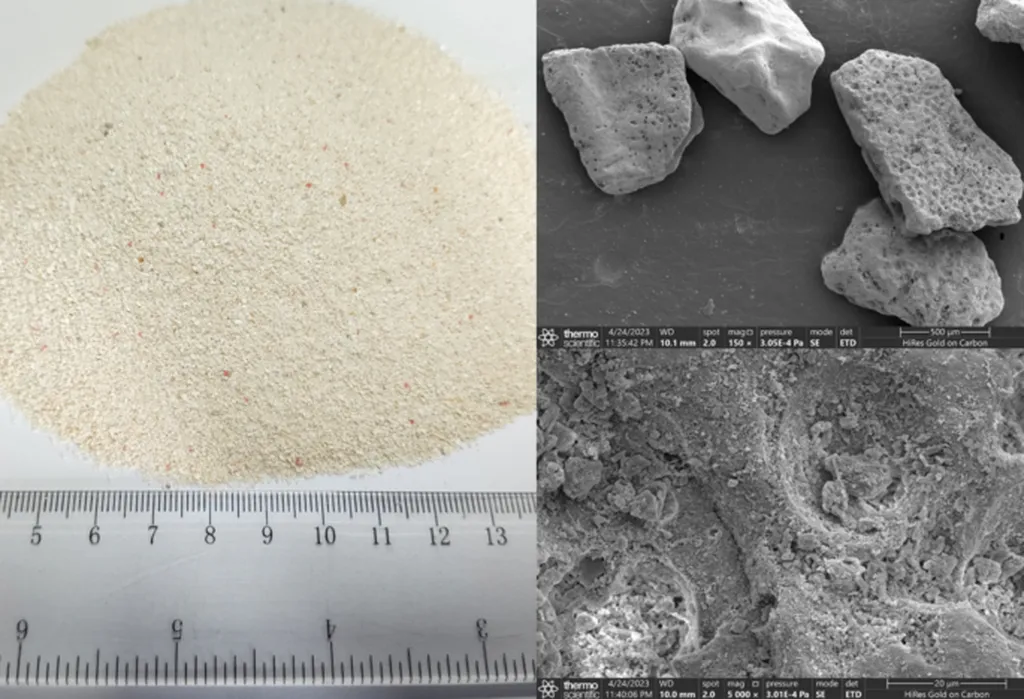
In the world of geotechnical engineering, understanding the behavior of soil is paramount, especially when it comes to the energy sector’s foundational work. A recent study published in *Yantu gongcheng xuebao* (Chinese Journal of Geotechnical Engineering) has shed new light on the unique properties of calcareous sand, a material often encountered in offshore wind farm and oil and gas exploration sites. The research, led by Dr. Wu Kai from the Institute of Geotechnical Engineering at Southeast University in Nanjing, China, introduces a novel discrete element numerical simulation method that could revolutionize how engineers approach soil mechanics in these critical industries.
Calcareous sand, unlike its quartz counterpart, possesses distinct characteristics that significantly influence its mechanical behavior. “The dual porosity structure, pronounced particle aspect ratio, and susceptibility to breakage are key factors that set calcareous sand apart,” explains Dr. Wu. These properties can greatly affect the stability and safety of offshore structures, making it crucial to understand their impact on cone penetration tests (CPT), a standard method used to assess soil strength.
The study’s simulations revealed that internal porosity—the tiny voids within the particles themselves—plays a pivotal role in the overall strength of calcareous sand. Meanwhile, external porosity, the spaces between particles, significantly affects the contact strength between them. As the internal and external porosity increase, the maximum values of cone tip resistance during CPT penetration decrease. This means that as the sand becomes more porous, it offers less resistance to penetration, which could have substantial implications for the design and safety of offshore structures.
Moreover, the aspect ratio of the particles—the ratio of their length to width—also plays a significant role. “The aspect ratio influences the packing behavior of calcareous sand, which in turn affects the CPT penetration outcomes,” says Dr. Wu. This finding underscores the importance of considering particle shape in geotechnical analyses, a factor often overlooked in traditional models.
The research also highlights the susceptibility of calcareous sand particles to breakage, with internal porosity being a crucial factor in this process. Understanding this behavior is essential for predicting the long-term stability of structures built on or in calcareous sand.
So, what does this mean for the energy sector? Offshore wind farms and oil and gas platforms often rely on accurate soil mechanics data to ensure their foundations are stable and safe. The findings from this study could lead to more precise modeling and prediction tools, ultimately reducing the risk of structural failures and improving the safety and efficiency of offshore operations.
Dr. Wu’s team’s work is a significant step forward in the field of geotechnical engineering. By incorporating the unique properties of calcareous sand into their models, engineers can make more informed decisions, leading to safer and more cost-effective offshore projects. As the energy sector continues to expand into deeper and more challenging environments, such advancements in soil mechanics will be invaluable.
The study, published in *Yantu gongcheng xuebao*, not only advances our scientific understanding but also paves the way for practical applications that could reshape the future of offshore construction. As Dr. Wu and his colleagues continue their research, the energy sector can look forward to more innovative solutions that address the unique challenges posed by calcareous sand.