
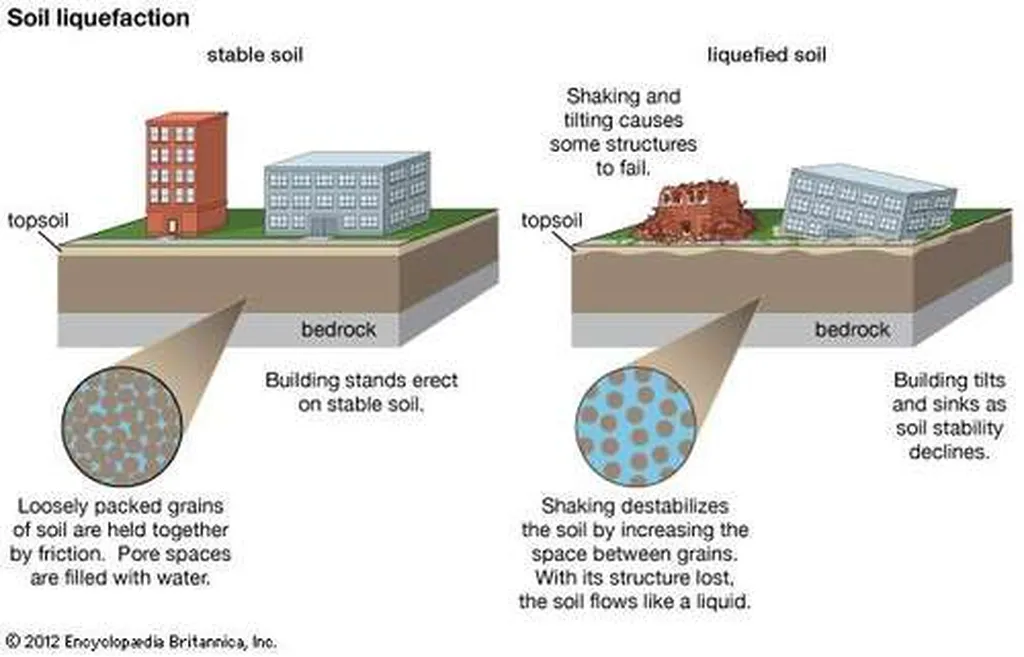
In the ever-evolving landscape of geotechnical engineering, a groundbreaking study led by Dr. Duan Wei from Taiyuan University of Technology, in collaboration with researchers from Southeast University and Anhui Jianzhu University, is set to revolutionize soil liquefaction evaluation. Published in the esteemed journal *Yantu gongcheng xuebao* (translated to *Chinese Journal of Geotechnical Engineering*), this research introduces a novel model that promises to enhance the accuracy and efficiency of soil liquefaction assessments, particularly for the energy sector.
The static cone penetration test (CPT) has long been a cornerstone in evaluating soil liquefaction potential. However, traditional methods based on equivalent pure sand have been limited in their applicability, primarily suited for sand and low plastic fine-grained soils. Dr. Duan Wei and his team have addressed this limitation by proposing a model that converts the cone tip resistance of CPT to the corresponding value of equivalent pure sand without the need for fine-grain content estimation or testing. This innovation is a game-changer for industries reliant on accurate soil assessments, including energy infrastructure development.
“The soil classification index, Ic, reflects the compressibility of soil and accounts for factors affecting penetration resistance, such as density and overconsolidation,” explains Dr. Duan Wei. “By integrating soil classification charts and the soil classification index to modify the cone-tip resistance, we can effectively evaluate liquefaction potential.”
The implications for the energy sector are profound. Accurate soil liquefaction evaluation is crucial for the safe and efficient construction of energy infrastructure, such as pipelines, wind farms, and offshore platforms. The proposed model offers a more precise and streamlined approach, reducing the risk of costly errors and delays. “This research provides a robust tool for engineers and geotechnical experts, ensuring that energy projects are built on stable and reliable foundations,” adds Dr. Zhao Zening, a co-author from Southeast University.
The study’s findings were validated through a practical example, demonstrating the model’s effectiveness in real-world scenarios. This validation underscores the potential for widespread adoption in the industry. As the energy sector continues to expand and diversify, the need for advanced geotechnical evaluation methods becomes increasingly critical. The research published in *Yantu gongcheng xuebao* not only meets this need but also sets a new standard for soil liquefaction assessment.
Dr. Cai Guojun, another lead author from Anhui Jianzhu University, highlights the broader impact: “This model is not just a technical advancement; it’s a step towards safer and more sustainable energy infrastructure. By improving our understanding of soil behavior, we can mitigate risks and enhance the longevity of critical energy projects.”
As the construction and energy industries continue to evolve, the integration of advanced geotechnical techniques will be paramount. The research led by Dr. Duan Wei and his team represents a significant leap forward, offering a more accurate, efficient, and reliable method for soil liquefaction evaluation. This innovation is poised to shape the future of geotechnical engineering, ensuring that energy projects are built on solid ground.