
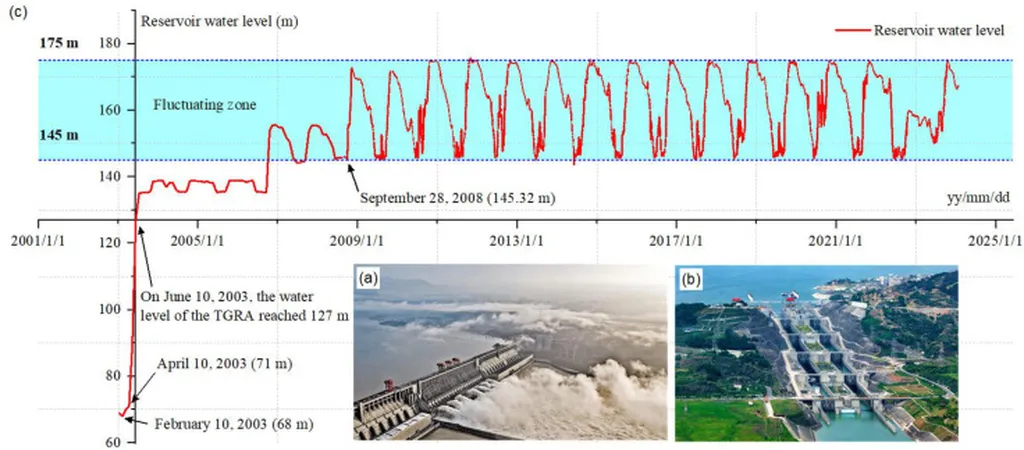
In the heart of China’s Three Gorges Reservoir area, a team of researchers from the Key Laboratory of Geological Hazards in Three Gorges Reservoir Area and the College of Civil Engineering & Architecture at China Three Gorges University has been delving into the intricate dance between rock, water, and stress. Their work, led by Dr. Luo Zuosen, is shedding light on the creep characteristics and deterioration mechanisms of limestone under the coupled effects of stress and water-rock interaction, with significant implications for the energy sector.
The Three Gorges Reservoir, a marvel of modern engineering, has always been a focal point for studies on rock mass deterioration, particularly in the riparian zone. The team’s research, published in the journal *Yantu gongcheng xuebao* (which translates to *Rock and Soil Engineering*), aims to simulate the complex interplay between the gravity of overlying strata and the periodic fluctuation of reservoir water levels. This simulation is crucial for understanding the long-term stability of reservoir bank slopes, a critical concern for the energy sector.
The researchers designed and conducted creep tests and microstructure tests on limestone samples from the hydro-fluctuation belt. Their findings reveal that the creep deformation of limestone samples increases with the rise in axial stress level and the duration of water-rock interaction periods. “Under a stress level of R≤0.75, the deformation tends to stabilize after a short water-rock cycle,” explains Dr. Luo. “However, when the stress level reaches R≥0.8, the samples ultimately fail, with higher stress levels leading to shorter cycles before failure.”
The study also uncovered that the internal structure of limestone samples deteriorates over time under the coupled effects of stress and water-rock interaction. The voids within the samples increase, and the structure gradually loosens. This deterioration process is driven by a cyclic interplay among water-rock interaction damage, crack propagation, and stress state adjustment.
The implications of this research for the energy sector are profound. Understanding the long-term deformation stability of reservoir bank slopes is vital for ensuring the safety and longevity of hydroelectric projects. “Our findings provide a theoretical foundation for analyzing the long-term deformation stability of reservoir bank slopes,” says Dr. Luo. This knowledge can guide the design and maintenance of hydroelectric infrastructure, potentially saving millions in repair costs and preventing catastrophic failures.
Moreover, the insights gained from this research could extend beyond the Three Gorges Reservoir. Similar rock mass deterioration issues are prevalent in other hydroelectric projects worldwide. By applying the findings from this study, engineers and scientists can better predict and mitigate the risks associated with water-rock interaction and stress coupling in various geological settings.
As the energy sector continues to evolve, the need for robust and reliable infrastructure becomes ever more critical. The work of Dr. Luo and his team represents a significant step forward in our understanding of rock mechanics and water-rock interaction. Their research not only enhances our ability to predict and prevent deterioration in hydroelectric projects but also paves the way for more innovative and sustainable energy solutions. In a world grappling with the challenges of climate change and energy security, such advancements are invaluable.