
In the heart of China’s Loess Plateau, where rainfall can be as unpredictable as it is intense, a team of researchers has developed a groundbreaking method to rapidly assess the risk of check dam breaches, a critical issue for the energy sector and regional infrastructure. Led by Dr. Wang Lin from the State Key Laboratory of Water Engineering Ecology and Environment in Arid Area at Xi’an University of Technology, the team’s work, published in *Yantu gongcheng xuebao* (Rock and Soil Engineering), offers a new approach to predicting and managing the devastating impacts of sudden dam failures.
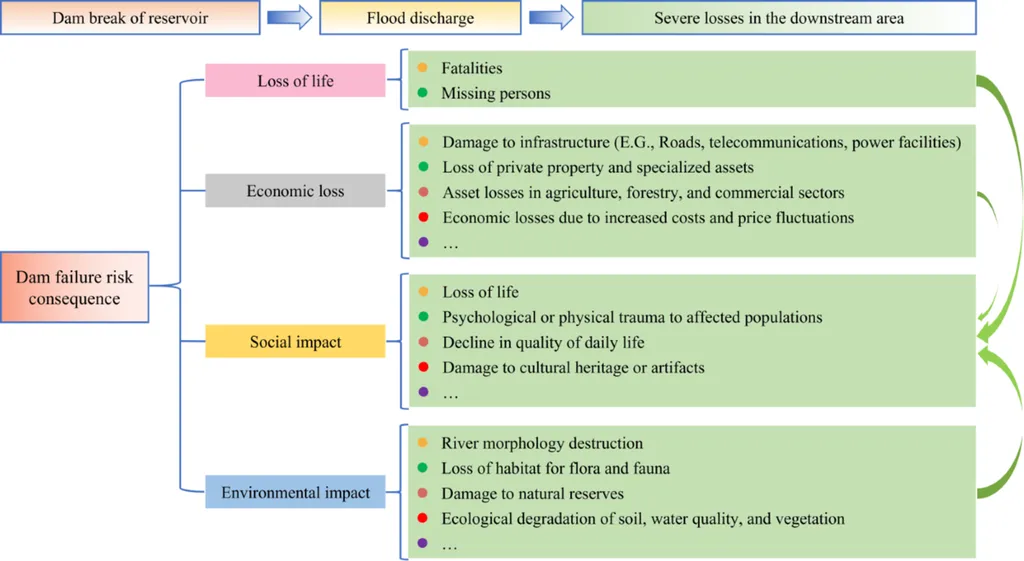
The Loess Plateau, known for its fragile ecosystem and frequent rainfall-induced disasters, has seen a rise in check dam breaches due to excessive rainfall. These structures, essential for soil and water conservation, play a pivotal role in maintaining the region’s ecological balance and supporting hydropower projects. However, their failure can lead to catastrophic consequences, including flooding and sediment disasters.
Dr. Wang and his team, including collaborators from the China Institute of Water Resources and Hydropower Research and the Nanjing Hydraulic Research Institute, have constructed a “rain flood sand breach” disaster evaluation method. This innovative approach integrates the coupling effect of “soil water sand” throughout the entire process of dam breach, establishing a mathematical model of water-sand dynamic dam breach specifically for check dams.
“Our model considers the dynamic interaction between water, soil, and sand, which is crucial for accurately predicting dam breaches,” explained Dr. Wang. “By incorporating these factors, we can provide more precise and timely evaluations, which are essential for issuing early warnings and implementing preventive measures.”
The team tested their model using data from the “7.15” rainfall event in the Wangmaogou watershed in 2012. Their findings were striking. By considering the impact of rainfall-induced runoff surges and sudden changes in sediment recharge, the model advanced the predicted peak flood times for three dams—Huangbaigou #1, Kanghegou #1, and Kanghegou #2—by 24 minutes, 21 minutes, and 26 minutes, respectively. Additionally, the peak flow rates increased by 4.24%, 1.53%, and 4.76%, respectively.
“This means that our model not only provides earlier warnings but also more accurate predictions of the severity of potential disasters,” said Dr. Wang. “This is crucial for the energy sector, as it allows for better preparation and mitigation strategies, ultimately protecting both infrastructure and lives.”
The research highlights the importance of considering sediment action in dam breach evaluations. Ignoring sediment action led to underestimations of the number of dam failures, particularly as rainfall increased. This underscores the necessity of incorporating sediment dynamics into risk assessments to ensure accurate and reliable predictions.
The implications of this research are far-reaching. For the energy sector, which relies heavily on hydropower projects in regions like the Loess Plateau, the ability to rapidly and accurately assess dam breach risks is invaluable. It enables better planning, more effective early warning systems, and more robust disaster mitigation strategies.
As Dr. Wang noted, “Our work is just the beginning. We hope that this model will be adopted widely and adapted to different regions and conditions, ultimately contributing to safer and more sustainable water management practices.”
With the increasing frequency and intensity of rainfall events due to climate change, the need for advanced predictive models like this one is more pressing than ever. This research not only advances the field of water resource management but also underscores the critical role of interdisciplinary collaboration in addressing complex environmental challenges.
In a world where natural disasters are becoming more unpredictable, the work of Dr. Wang and his team offers a beacon of hope, providing tools to better understand and mitigate the risks associated with check dam breaches. As the energy sector continues to evolve, such innovations will be crucial in ensuring the safety and sustainability of our infrastructure and communities.